

Buying tickets for a major event sounds straightforward until you are staring at a sold-out page, a suspicious resale listing, or a barcode that will not scan at the gate. The event ticket purchase checklist exists precisely because the process has real consequences when it goes wrong. Scams, hidden fees, invalid tickets, and entry refusals are not rare edge cases. They happen regularly to people who skipped a step or trusted the wrong source. This guide covers every stage of the process, from initial research through to event-day entry, so you arrive prepared and get in without issue.
Table of Contents
- Key takeaways
- Your event ticket purchase checklist: before you buy
- How to buy event tickets: the purchase process
- Buying sold-out or hard-to-get tickets safely
- Troubleshooting and event-day entry preparation
- Exclusive access and invitation-only events
- My take on buying tickets without the stress
- How A1lifestyle can handle this for you
- FAQ
Key takeaways
| Point | Details |
|---|---|
| Prepare accounts early | Register on official ticketing platforms before sale day to avoid delays at checkout. |
| Budget for fees | Service fees add 20 to 30% or more on top of the base ticket price. |
| Use verified resale only | Stick to platforms with buyer protection policies when the primary sale is sold out. |
| Never rely on screenshots | Static screenshots are often rejected at venues using dynamic barcode technology. |
| Understand exclusivity rules | VIP and invite-only tickets frequently carry non-transferability conditions and ID requirements. |
Your event ticket purchase checklist: before you buy
The groundwork you lay before the sale opens determines how smoothly everything else goes. Most ticket purchase problems start here, not at the checkout.
Choose the right platform first. Official event websites, venue box offices, and authorised ticketing partners are the safest starting points. If you are unsure whether a platform is official, check the event's own website or social media pages for links. Third-party sites that do not appear there should be treated with caution.
Set a realistic budget. The listed ticket price is rarely what you pay. Service fees can add 20 to 30% or more to the base cost, and that figure does not include travel, parking, or hospitality. Know your ceiling before you start browsing, so you are not making rushed decisions under pressure.
Create and verify your accounts in advance. Most major ticketing platforms require a registered account to complete a purchase. Set yours up days before the sale, not minutes before. Verify your email address, add a payment method, and confirm your billing details are correct. Account verification failures at the moment of purchase are one of the most common reasons people miss out.
Check transfer and ID policies. Some events, particularly high-demand concerts and sports fixtures, restrict ticket transfers or require the original purchaser to present ID at the gate. Many events now limit transfers to combat scalping and fraud. Read the terms before you buy, not after.
- Confirm the event date, time, and venue
- Identify the official ticketing partner for that event
- Note any presale codes available through fan clubs or credit card providers
- Check whether the event is general admission or assigned seating
- Review the refund and exchange policy
Pro Tip: Sign up for the artist or team's official newsletter at least a month before any major event. Presale codes are frequently distributed this way and can give you access to tickets hours before the general public.
How to buy event tickets: the purchase process
When the sale opens, speed and preparation matter. Here is a step-by-step process to follow.
- Log in before the queue opens. Most platforms open a virtual queue at a set time. Being logged in and on the correct page before that moment gives you the best starting position.
- Select your ticket type carefully. General admission, seated, VIP, and hospitality packages all have different implications for your experience and your budget. Do not select the first available option without checking what it includes.
- Add tickets to your basket promptly. Inventory can disappear within seconds for high-demand events. Once you have selected your tickets, move through the checkout without stopping to reconsider.
- Double-check all details before payment. Confirm the event name, date, venue, quantity, and ticket type. Errors at this stage are difficult to reverse once payment is processed.
- Use a secure payment method. Credit cards offer the strongest consumer protections for online purchases. Avoid payment methods that cannot be disputed if something goes wrong.
- Save your confirmation immediately. Screenshot or download your order confirmation as soon as it appears. Note the booking reference and the platform you used.
- Check your email for the confirmation. Most platforms send a confirmation within minutes. If it does not arrive, check your spam folder and then contact the platform's support team.
Pro Tip: If you are buying tickets for a group, coordinate with everyone beforehand on the exact quantity and seating preferences. Changing your selection mid-checkout can cause you to lose your place in the queue.
Once your tickets are confirmed, check whether you need to accept them within a specific app. A ticket is only fully secured upon acceptance in the official event app. Payment alone does not always guarantee entry.
Buying sold-out or hard-to-get tickets safely
When an event sells out, the options narrow, but they do not disappear. The key is knowing which options are legitimate.

Official waitlists and fan exchanges. Many promoters and venues operate official waitlists or fan-to-fan exchanges at face value. These are always the first port of call. They carry no fraud risk and often include the same buyer protections as the original sale.
Verified resale platforms. Verified resale platforms offer buyer protections including refund policies and legitimate transfer processes. Look for platforms that guarantee the ticket's validity and offer a clear process for resolving issues. Compare the total cost across platforms, including all fees, before committing.
| Platform type | Buyer protection | Price transparency | Fraud risk |
|---|---|---|---|
| Official resale | High | Clear | Low |
| Verified resale marketplace | Medium to high | Variable | Low to medium |
| Unofficial broker or individual seller | None | Poor | High |
- Compare "all-in" pricing across at least two verified platforms before purchasing
- Confirm that the ticket can be transferred to your account or app
- Check the delivery method: mobile transfer is standard; physical tickets are increasingly rare
- Verify that the seat or section matches what is advertised
Always avoid irreversible payment methods. Wire transfers and cryptocurrency payments offer no recourse if the ticket is fraudulent or never delivered. Use a credit card or a platform with an integrated payment guarantee.
For VIP concerts and premium sporting fixtures, specialist concierge services with verified access to sold-out inventory are a practical alternative to the resale market.
Troubleshooting and event-day entry preparation
The period between purchase and entry is where many people encounter unexpected problems. Most of these are avoidable.
Understand barcode release timing. Official barcodes are commonly released 24 to 48 hours before the event. This is a deliberate security measure, not a sign of a problem with your ticket. Delayed barcode visibility helps prevent scalping and fraud. Do not panic if your barcode is not visible a week before the event.
Never use screenshots as your ticket. Static screenshots are frequently rejected at venues using dynamic barcode or NFC technology. The barcode on a screenshot does not update, which means it can be duplicated and used by someone else. Always present your ticket through the official app.
Pro Tip: Download the relevant ticketing app and log in at least 48 hours before the event. Check that your ticket appears correctly in the app and that your phone is charged. A dead phone at the gate is a preventable problem.
Prepare for entry by checking the following:
- Download and log into the official ticketing app before the event day
- Use the official platform's app to present your ticket, not a browser or screenshot
- Check the venue's entry requirements, including ID policies and age restrictions
- Arrive with enough time to resolve any entry issues before the event starts
- Know the venue's contact number or help desk location in case your ticket fails to scan
If your ticket does not scan at the gate, stay calm. Locate the venue's customer service point and present your booking confirmation and the original payment receipt. Most venues have a resolution process for genuine purchase issues.
Exclusive access and invitation-only events
Not all events are open to general sale. Understanding how exclusivity works in events can help you plan your approach and set realistic expectations.
Exclusivity drives demand through perceived scarcity and social proof, but it also comes with specific access conditions. Invite-only events, VIP packages, and premium hospitality experiences operate differently from standard ticket sales.
The exclusive event invitation process typically involves one or more of the following:
- Direct invitation from the organiser or a sponsor partner
- Entry into a ballot or lottery system, as used by events like Wimbledon and the Formula 1 British Grand Prix
- Membership of a fan club, loyalty programme, or credit card scheme that grants presale or exclusive access
- Purchase through a specialist concierge or hospitality provider with pre-allocated inventory
Waitlists and lotteries increase fairness and help manage demand for exclusive events. They are also, as noted in research on Apple's WWDC approach, powerful engagement tools when managed transparently. Signing up early and following the organiser's instructions precisely improves your chances.
Exclusive tickets usually require strict protocols such as non-transferability or verified identity at entry. When arranging VIP event access, confirm these conditions before purchase. A VIP ticket that cannot be transferred is worthless if you cannot attend.
My take on buying tickets without the stress
I have seen people lose hundreds of pounds on tickets that were never valid, and I have also seen people secure front-row seats to sold-out events by simply doing the preparation correctly. In my experience, the gap between those two outcomes is almost always about process, not luck.
The most common misconception I encounter is that resale is inherently risky. It is not, provided you use the right platforms and understand what you are buying. The risk comes from impatience and from choosing unofficial sellers because they are cheaper or more convenient.
What I have also learned is that digital tickets create a false sense of security. People assume that because they have a confirmation email, they are sorted. They are not. The ticket needs to be accepted in the correct app, the barcode needs to be live, and the device needs to be working on the day. I have spoken to people who were turned away at the gate because they had not completed the acceptance step.
My advice is straightforward. Follow the checklist. Do not skip steps because you are in a hurry. And if an event matters enough to spend significant money on, it matters enough to spend an hour preparing properly.
— Tony
How A1lifestyle can handle this for you
If following every step of this process sounds like more effort than you want to invest, that is precisely where A1lifestyle comes in.
A1lifestyle has over 30 years of experience securing access to sold-out and high-demand events worldwide. Whether you are looking for Premier League hospitality or VIP concert packages, the team handles the entire ticket acquisition process on your behalf. That includes sourcing verified tickets, managing transfers, and providing concierge support from purchase through to entry. You do not need to monitor presales, compare resale platforms, or worry about barcode timing. A1lifestyle's concierge services are designed for people who want the experience without the process.
FAQ
What is an event ticket purchase checklist?
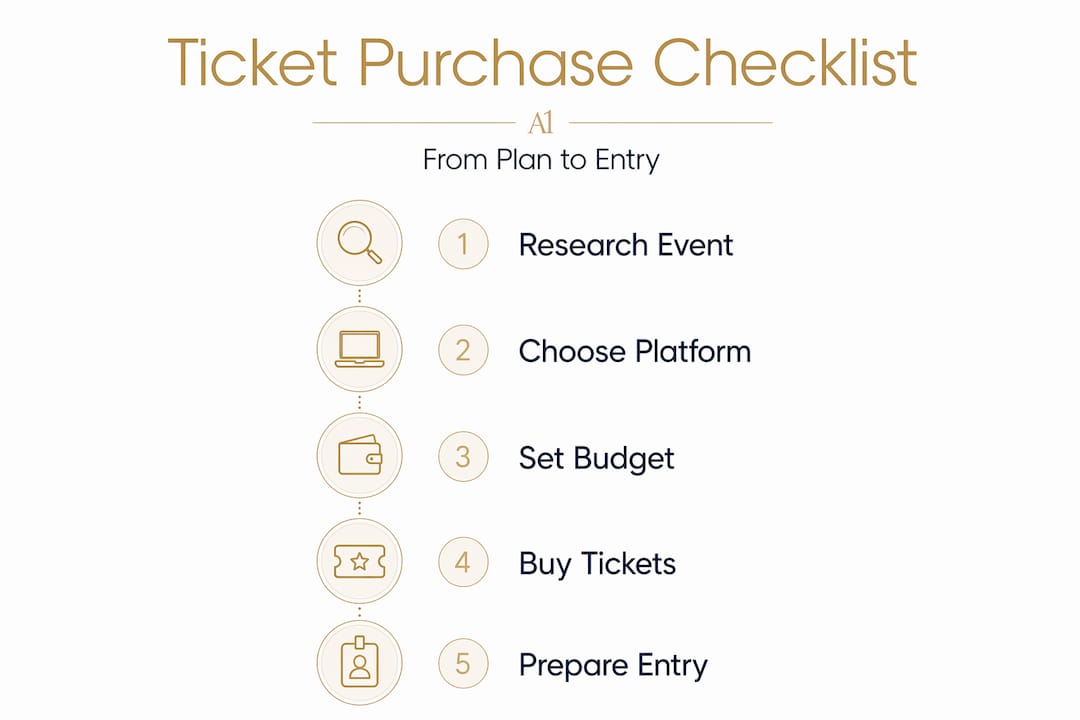
An event ticket purchase checklist is a structured list of steps covering research, budgeting, platform selection, checkout, and entry preparation. It helps buyers avoid common mistakes such as missed presales, hidden fees, and invalid tickets.
How early should I buy event tickets?
For high-demand events, buy as early as possible, ideally during presale windows. For lower-demand events, prices can drop closer to the date, but availability is not guaranteed.
Are resale tickets safe to buy?
Resale tickets are safe when purchased through verified platforms that offer buyer protection. Avoid individual sellers and any payment method that cannot be disputed, such as wire transfers or cryptocurrency.
Why is my ticket barcode not showing yet?
Barcodes are typically released 24 to 48 hours before the event as a security measure. This is normal. Check the official app closer to the event date rather than a third-party email link.
How do I gain exclusive access to invite-only events?
Join official fan clubs, sign up for organiser newsletters, and register for any available ballot or waitlist as early as possible. Specialist hospitality providers like A1lifestyle also offer pre-allocated access to events that are not available through general sale.