

TL;DR:
- Understanding event seating categories helps you make informed choices by reflecting view quality, location, and amenities. Different event types, such as concerts, sports, and theatre, have unique category structures, with seat maps providing crucial layout insights before purchasing. Carefully researching, planning fallback options, and prioritizing your preferences ensure a satisfying experience and value for your investment.
Understanding how event seating categories work can save you money and prevent disappointment. Pick the wrong section at a concert or a sports match and you may end up with a restricted view, a poor atmosphere, or a price that did not match the experience. This guide covers the structure of seating categories across concerts, sports events, and shows, explaining what the category labels actually mean, how pricing reflects them, and what to look for before you buy.
Table of Contents
- Key takeaways
- How event seating categories work
- Seating categories by event type
- Accessibility and restricted-view seats
- How to choose the right seating category
- My take on navigating seating categories
- Plan your next event with A1lifestyle
- FAQ
Key takeaways
| Point | Details |
|---|---|
| Categories reflect view quality | Seating categories are based on location, sightlines, and amenities, not just distance from the stage. |
| Event type shapes the structure | Concerts, sports venues, and theatres use different naming systems, from GA zones to numbered tiers. |
| Premium seats bundle extras | Higher categories often include club access, hospitality, and private facilities beyond a better view. |
| Restricted views carry real risk | Obstructed or limited-view seats can be 40 to 60% cheaper but come with significant sightline drawbacks. |
| Plan with a backup category | Treat categories as approximate view-quality bands and prepare a second-choice option before tickets go on sale. |
How event seating categories work
Seating categories divide a venue into zones that reflect the quality of the view, the distance from the action, and the level of comfort or amenities on offer. The category a seat falls into determines its price. Two seats in different categories can be in the same physical area of a stadium yet carry a price difference of hundreds of pounds.
Most venues use one of two systems. The first assigns seats a fixed category number or letter, such as Category 1 through to Category 4, where Category 1 represents the best central views and Category 4 the most distant or awkwardly angled positions. The FIFA World Cup, for example, groups seats into categories 1 to 4 based on view quality, height, and angle, with central lower-tier positions as Category 1 and the highest, farthest corner areas as Category 4.
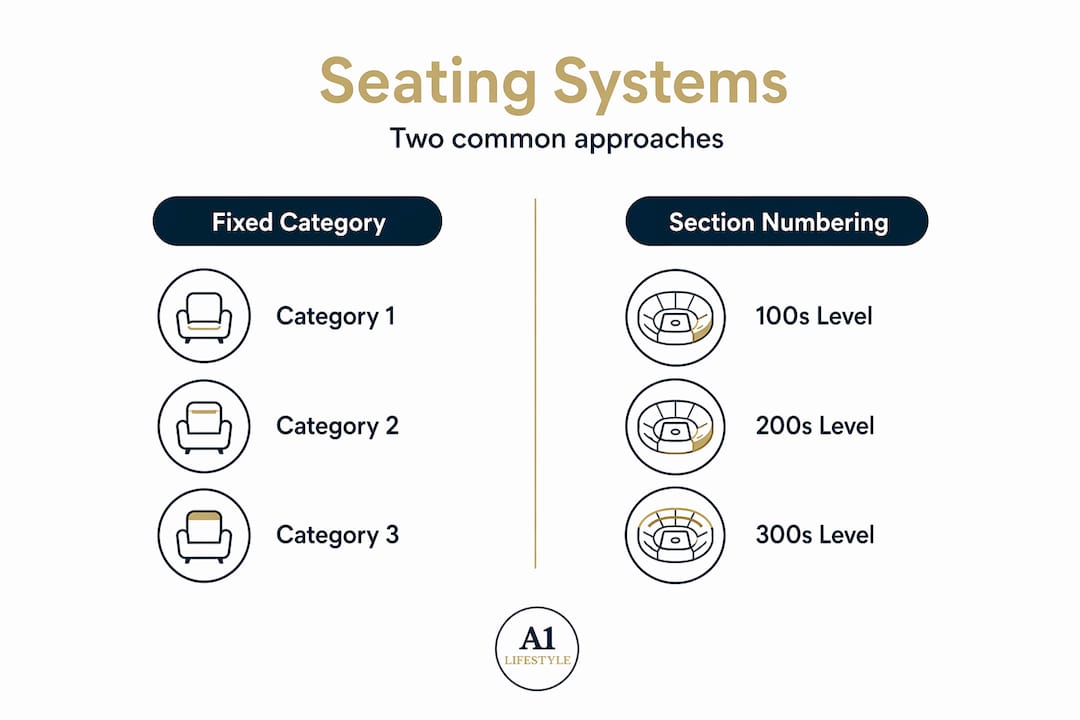
The second system uses section and row numbering. In many large arenas, section numbers follow a pattern where the hundreds digit indicates the level. Sections in the 100s sit in the lower bowl, the 200s indicate club level, and the 300s mark the upper bowl. This system tells you both the zone and the precise row before you ever look at a map.
Seat maps are the main tool for understanding seating arrangements before purchase. They display the venue layout visually, with each section colour-coded by category or price band. Reading the map legend is non-negotiable. Seating maps and numbering vary across venues, and what counts as a premium position at one arena may be mid-tier at another.
The types of event seating arrangements also vary by event format. A theatre performance uses stalls, circles, and balconies. A stadium concert blends numbered reserved sections with general admission floor zones. A Formula 1 race has grandstands, premium terraces, and hospitality suites. Each format has its own category logic.
Seating categories by event type
Different events structure their seating categories in distinct ways. Understanding the conventions for each type helps you decode ticket listings without confusion.
Concerts
Concert venues typically separate the floor or pit from the seated sections. General admission floor tickets offer proximity to the stage but no guaranteed position and no seat. Reserved seated sections are grouped into categories based on distance from the stage and elevation angle.
- General admission (GA): Standing, unreserved, usually the floor in front of the stage. Best for atmosphere, worst for comfort on a long night.
- Premium reserved: Front sections with direct sightlines, often including early entry or meet-and-greet access.
- Standard reserved: Mid-distance sections offering a balanced view without the premium price.
- Restricted or limited view: Seats behind rigging towers, pillars, or at extreme side angles. Often cheaper, but the obstruction can be severe.
For VIP concert experiences, the top category typically adds hospitality lounges, dedicated bar access, and sometimes private viewing areas entirely separate from the main bowl.
Sports events
Sports venues use tiered bowl structures. The lower bowl is closest to the pitch or court and commands the highest standard prices. The upper bowl is higher and farther back, offering a broader view of the full playing area but less immediate atmosphere.
| Category | Position | Typical extras |
|---|---|---|
| Lower bowl / Category 1 | Closest to the action | Best view of play, pitch-level atmosphere |
| Club level | Mid-tier, elevated | Lounge access, waitstaff, padded seating |
| Upper bowl | Highest tier | Wide aerial view, lower price point |
| Hospitality suite / box | Private enclosed unit | Catering, TVs, private entrance, concierge |
Club seats at many venues bundle in significant perks. Premium sports seating commonly includes all-inclusive food and drink, private restrooms, VIP parking, and dedicated concierge services. The price reflects this package, not just the seat location.
For Premier League football or high-profile sports events, the distinction between a club seat and a standard seat can be several hundred pounds per match, with the added value lying in the surrounding hospitality rather than the view alone.
Theatre and shows
Theatre seating uses specific traditional terms. The stalls are the ground floor seats closest to the stage and generally the most expensive. The dress circle or royal circle sits one level up and offers an elevated view that many experienced attendees prefer for musicals and drama. The upper circle or balcony is higher still, cheaper, and can feel distant from the action. A full range of shows carries this tiered structure across most major venues.
The angle matters in theatre more than at sports events. Front stalls can mean craning your neck upward if the stage is high. Mid-stalls and the front circle often offer the most comfortable viewing angle for most productions.
Accessibility and restricted-view seats
Two categories of seats require particular attention: accessible seating and restricted or obstructed-view positions.
Accessible seating rules
Accessible seating is not a discounted zone. Under ADA requirements, accessible seats must be priced the same as comparable non-accessible seats and must be available across all price categories where practicable. Companion seats are required alongside accessible positions, and venues must provide information about these seats with the same level of detail as standard tickets.
This matters for event planning because:
- Accessible seats are not automatically the cheapest option.
- They are distributed across multiple categories, including premium zones.
- Pricing parity is a legal requirement, not a policy choice.
Restricted and obstructed views
Restricted-view seats are priced lower, sometimes significantly. Seats behind stage rigging, next to structural pillars, or at extreme angles can cost 40 to 60% less than their neighbours. However, the obstruction can render parts of the performance invisible. Checking the seat map legend and searching for venue photos from the specific section before purchasing is the most reliable way to assess the real impact.
Pro Tip: Search the venue name and section number on social media or photo-sharing platforms. Attendees frequently post photos taken from their seats, which gives a realistic view that no official map can match.
Some venues label these seats honestly with "limited view" or "restricted view" in the ticket listing. Others do not. Reading the small print on ticket pages and cross-referencing with the official venue map reduces the risk considerably.
How to choose the right seating category
Making a confident choice between seating categories requires a process, not guesswork.
- Set your priority first. Decide whether atmosphere, view quality, or comfort matters most to you for this specific event. A standing GA ticket at a rock concert delivers something entirely different from a club seat at a Premier League match, even if the prices overlap.
- Study the seat map before tickets go on sale. Familiarise yourself with the venue layout so you are not learning it in real time during a high-demand on-sale window.
- Treat categories as view-quality bands, not fixed guarantees. Ticket categories indicate approximate viewing quality, not identical experiences within the zone. Two seats in Category 2 can differ noticeably depending on their row and angle.
- Prepare a fallback category. If your first choice sells out quickly, knowing your second preference lets you act immediately rather than settling for whatever remains.
- Check the row and seat number, not just the category. Rows in lower sections often start with letters at the front, while upper sections sometimes number from the back. Knowing this prevents the common mistake of assuming row A is always the closest.
- Assess the premium tier value honestly. If the event is a once-in-a-lifetime occasion, the hospitality package that comes with top-tier seating may justify the price. If it is a regular season fixture, standard seating often delivers the same core experience.
Pro Tip: For events where seating categories are sold as zones rather than specific seats, choose central positions over closer side-angle spots. A seat 15 rows back in the middle of a concert floor often provides a better overall experience than the fifth row at a sharp angle.
For events with a budget planning element, allocating your spend based on the type of event and your attendance frequency is a practical approach. Spend more on the events that matter most, and use standard categories for those you attend regularly.
My take on navigating seating categories
I have attended enough events across enough venues to say with certainty that most people buy tickets without properly reading the seat map. I have done it myself. The result is usually fine, but occasionally it is a pillar blocking the left quarter of the stage, or a seat so steeply raked that the view is technically unobstructed but physically uncomfortable for two hours.
The uncomfortable truth about certain discounted seats is this: the price discount exists for a reason. Venues are not offering charity. If a seat in the third row costs the same as one in the twentieth row, there is an obstruction or angle problem that the listing may not advertise clearly. I have learnt to treat any significant price drop within a section as a signal to investigate before purchasing, not after.
Premium seating is worth the investment in specific circumstances. When the event includes genuine hospitality, a private entrance, and dedicated facilities, the difference in the day is real. When premium simply means the front few rows without any added service, the value calculation is less obvious.
The crowd atmosphere debate is real too. I have sat in technically superior seats at football matches and felt less engaged than when I was in a cheaper section surrounded by passionate supporters. For sport especially, atmosphere is part of the product. Category 1 seats closest to the pitch at a flat atmosphere fixture can feel oddly quiet compared to a packed upper tier behind the goal.
Plan your seating choices deliberately. Read the map, check the category description, and know what you are prioritising. It takes ten minutes and it consistently produces a better result.
— Tony
Plan your next event with A1lifestyle
A1lifestyle provides access to premium and sold-out event tickets across concerts, sports, and shows worldwide, backed by over 30 years of industry experience. Whether you are looking for VIP concert seats with hospitality access, or exclusive hospitality packages for Premier League matches, F1 races, and major live shows, the team handles every detail. Services include VIP lounges, private box bookings, concierge support, and guaranteed access to high-demand events. For corporate event entertainment ideas, premium seating options can be tailored to group requirements. Explore the full range of available tickets and packages directly through A1lifestyle to secure the experience that matches your expectations.
FAQ
What are event seating categories?
Event seating categories are zones within a venue that group seats by view quality, location, and amenities. Category 1 or equivalent typically represents the best central views, while higher category numbers indicate more distant or angled positions.
How do I read a venue seat map?
Look at the section numbering first. In many venues, sections in the 100s indicate the lower bowl, 200s the club level, and 300s the upper bowl. Colour coding on the map shows which category each section belongs to.
Are accessible seats cheaper than standard seats?
No. Accessible seating must be priced the same as comparable non-accessible seats across all price categories, as required by accessibility legislation. They are distributed throughout the venue, including in premium zones.
What does restricted view mean on a ticket?
Restricted view means part of the stage or playing area is obscured by a structural element such as a pillar, rigging, or platform. These seats are often sold at a discount but the obstruction can significantly affect the experience.
When is premium seating worth the extra cost?
Premium seating is worth the added price when it includes genuine extras such as hospitality lounges, all-inclusive food and drink, private facilities, or VIP parking. For events you attend regularly, standard seating typically delivers the same core experience at a lower cost.