
TL;DR:
- Stadium hospitality involves structured access controls, staffing, and operations that vary across tiers and influence guest experience. Different levels offer distinct services, from basic lounge access to private suites, with operational details shaping the actual experience. Selecting the right tier requires verifying inclusions, understanding logistical constraints, and considering event objectives for optimal enjoyment and value.
Stadium hospitality is commonly misunderstood as simply a better seat with a free drink at half-time. In reality, understanding how stadium hospitality levels work reveals a structured system of access controls, catering operations, staffing ratios, and guest movement protocols that differ substantially between tiers. For event planners and sports enthusiasts alike, knowing these distinctions affects budget decisions, guest satisfaction, and logistical planning. This guide breaks down the full picture, from entry-level club seats to private suites, covering what each level actually delivers in operational and experiential terms.
Table of Contents
- Key takeaways
- How stadium hospitality levels work: the core structure
- Guest flow and operational mechanics
- Variations across venues and events
- Choosing the right hospitality level
- Trends shaping stadium hospitality
- My take on hospitality tiers
- How A1lifestyle can help
- FAQ
Key takeaways
| Point | Details |
|---|---|
| Tiers go beyond seating | Each hospitality level differs in lounge access, catering, staffing, and guest flow controls, not just seat quality. |
| Guest movement is restricted | Suite-level guests typically cannot move freely between levels, which affects group logistics and arrival planning. |
| Tier names vary by venue | The same tier label means different inclusions at different stadiums, so always verify package details before booking. |
| Staffing scales with premium capacity | Larger premium sections require dedicated concierge leadership, not just additional box numbers. |
| VIP hospitality serves business goals | 72% of VIP guests report generating business through hospitality networking environments. |
How stadium hospitality levels work: the core structure
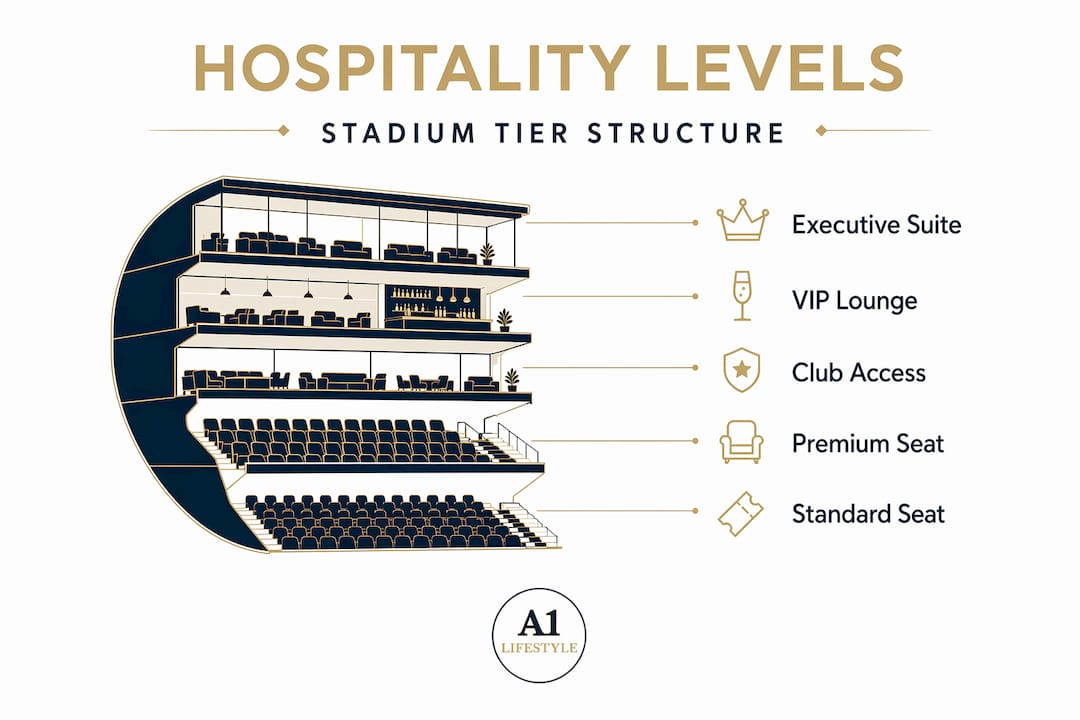
The foundation of stadium hospitality explained properly starts with recognising that each tier is a bundled service product, not just a seating category. Football hospitality tiers typically include a premium seat, private lounge access, and pre and post-match catering as a baseline structure. The three broad tiers found across most major stadiums are as follows.
- Entry-level padded or club seating. This tier offers improved physical comfort over standard seats and may include access to a shared lounge before kick-off. Catering is usually a buffet or set menu, and service staffing is light.
- Executive or club lounges. This mid-tier provides dedicated lounge access for a defined period, table service or a more curated food offering, and a better seat location within the stadium bowl. Some packages include parking.
- Private boxes and presidential suites. Executive boxes offer balcony seating, personal hosting, fine dining, VIP access, and parking. Top-tier packages include concierge staff and strict dress codes, with full privacy from other guests.
What separates these levels is not only what is included but how those inclusions are delivered. A mid-tier lounge with table service and a trained host is a fundamentally different experience to a self-service buffet in a shared space, even if both are technically labelled "hospitality."
Pro Tip: When evaluating what is stadium hospitality for a group booking, list out every component separately. Seat location, lounge access window, catering style, parking, and staffing each carry independent value and should be compared item by item across packages.
Guest flow and operational mechanics
Hospitality tiers are, at their core, guest flow and service orchestration mechanisms. The operational design behind each level is what produces the experience, and it differs considerably from standard ticketing.
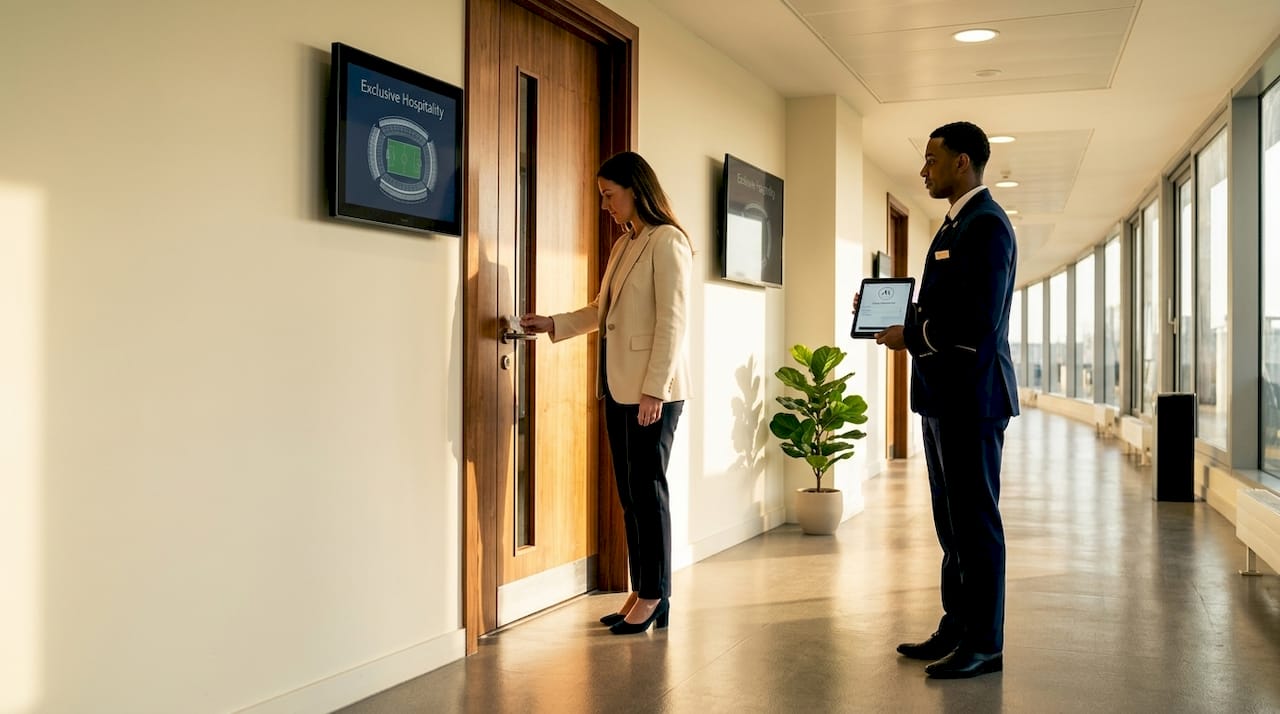
Suite guests often cannot leave the suite level during events, and there is no guest pass exchange between zones. This is a deliberate design choice to prevent cross-traffic and maintain the exclusivity of each tier. For event planners, this has a direct logistical implication: groups must be consolidated before arrival, as reuniting separated guests mid-event is not straightforward.
- Dedicated entrances and security lanes. Club-level ticket holders at many venues use separate entrances with shorter queues, which reduces arrival stress and sets the tone for the experience from the moment guests arrive.
- Concierge teams and staffing ratios. At suite level, a dedicated concierge is assigned to a defined number of guests. This staffing ratio is central to service quality and is a key operational differentiator between tiers.
- Time-limited support windows. Suite concierge staff are typically reachable within a window running three hours before to one hour after the event. Planners should note this constraint when organising post-event logistics or late arrivals.
- Suite-level design and cross-traffic prevention. Suite-level hospitality is physically separated from other zones to support controlled access, meaning guests enjoy exclusive amenities without interference from other ticketing levels.
"Hospitality tiers are essentially guest flow and service orchestration mechanisms, not just seat upgrades. The physical and staffing design of each level shapes every aspect of the guest experience before, during, and after an event." — MLB Giants Suite Experience
Understanding how stadium service levels differ at the operational level is what separates competent event planning from exceptional event planning. The mechanics behind access, movement, and staffing are just as important as the menu or the seat view.
Variations across venues and events
One of the most common mistakes when selecting hospitality options in stadiums is assuming that the same tier name means the same experience at every venue. It does not.
Service quality, menu, lounge access, and seat quality differ considerably even when tiers carry similar labels. A "Club Level" package at one stadium may include a three-course meal and a dedicated host. At another, it may mean a seat in a heated concourse with a set menu. The label is a starting point, not a guarantee.
- Verify every inclusion individually. Contact the venue or hospitality provider directly and ask for a written breakdown of what is included: lounge access times, catering format, seat location, parking, and service staffing.
- Account for event importance. Pricing and inclusions shift between a Premier League title fixture and a midweek cup game at the same ground. Premium packages during high-demand events may offer fewer extras at higher prices.
- Assess lounge style and privacy. Some hospitality lounges are open-plan and shared across multiple packages. Others are private to a specific box or suite. The physical environment affects the atmosphere considerably.
- Check dress codes and entry requirements. Top-tier packages, particularly at Emirates Stadium, often include formal dress requirements and entry protocols that guests must be briefed on in advance.
Pro Tip: Always request a floor plan or seating chart alongside the package brochure. Knowing the physical relationship between the lounge and the seat helps guests plan their time and movement across the event day.
Choosing the right hospitality level
For event planners and enthusiasts, selecting the appropriate level requires a structured approach. The decision involves more than budget. It involves matching service capabilities to guest expectations.
| Factor | Lower tier | Higher tier |
|---|---|---|
| Seat location | Mid-tier stand | Premium central or halfway line |
| Catering | Buffet or set menu | Table service or fine dining |
| Lounge access | Pre-match only | Pre and post-match |
| Staffing | Shared service team | Dedicated concierge per suite |
| Guest movement | General concourse access | Restricted to suite level |
| Parking | Separate or not included | Included and adjacent |
Beyond the table above, the following considerations shape the final decision.
- Group size versus box pricing. Private boxes are priced per box, not per person, so smaller groups often find the per-head cost higher than a mid-tier club seat. For groups above ten, boxes frequently offer better value per person.
- Travel and logistics. Some hospitality packages include bundled travel such as flights, hotels, and transfers for overseas fans. For international guests, this integration removes considerable logistical pressure.
- Business versus leisure objectives. Research shows that VIP hospitality environments are used strategically to support networking and client relationship-building. If the event has a commercial purpose, the privacy and exclusivity of a suite justifies the additional cost.
- Catering service timing. Premium hospitality involves a specialised service choreography with pre-planned food service flows, not standard concessions. Understanding when food is served relative to kick-off helps planners manage guest expectations.
Trends shaping stadium hospitality
The stadium hospitality sector is not static. Modern renovation programmes and shifting guest expectations are actively changing how hospitality options in stadiums are structured and staffed.
- Expansion of premium seating. Capital One Arena increased its premium seating proportion from 15% to 35% and added 30 new premium spaces, reflecting a broader industry shift towards high-margin tier expansion.
- Concierge leadership investment. Expanding premium capacity requires additional staffing layers and leadership roles, not only added box numbers. Venues are investing in concierge captains and trained service teams to maintain quality as volume grows.
- Personalised service models. The future of stadium foodservice involves fewer menu items delivered with higher precision and staffing ratios, allowing for a more personalised guest experience in premium areas.
- Technology integration. Digital pre-ordering, in-suite screens, and mobile concierge apps are being introduced across venues to reduce friction and improve service responsiveness at the highest tiers.
- Transport and arrival experiences. Some premium packages now incorporate private helicopter transfers and chauffeured arrivals as standard inclusions, extending the hospitality experience well beyond the stadium itself.
The direction is clear. Stadium VIP experience standards are rising, and venues are investing substantially in the operational infrastructure required to deliver them consistently.
My take on hospitality tiers
I have spent a considerable amount of time working around multi-tiered hospitality environments, and the thing that consistently surprises people is how little the tier label actually tells you. I have seen executive lounge packages that delivered genuine attentive service and genuinely memorable meals. I have also seen packages with the same name and a similar price that amounted to a cold buffet and a seat nobody wanted.
What I have learned is that the real differentiator is operational control. The venues that get hospitality right have thought carefully about staffing ratios, guest movement, service timing, and the physical layout of the space. The ones that get it wrong are simply charging more for a seat and calling it VIP.
For planners specifically, my view is that the most useful thing you can do before any booking is ask the provider a simple operational question: "What happens if a guest in my group arrives 45 minutes before kick-off and another arrives 10 minutes before?" The answer will tell you more about the quality of the operation than any brochure ever will. It tests whether the venue has thought about real guest scenarios or just sold you an idealised version of the experience.
The VIP experiences that earn loyalty are those where the operational design makes every guest feel that the service was arranged specifically for them, even when it was not.
— Tony
How A1lifestyle can help
A1lifestyle has over 30 years of experience arranging premium stadium hospitality for sports events and concerts worldwide. Whether you are planning a corporate group outing or attending as an enthusiast who wants the full package, A1lifestyle handles the operational complexity so guests can focus on the event.
The Premier League hospitality packages available through A1lifestyle cover the full range of service tiers, from executive lounge access to private suite bookings at top-flight grounds. For Arsenal-specific events at the Emirates, the Arsenal hospitality packages include dedicated concierge support and curated match-day experiences. A1lifestyle also offers VIP concert packages and a broad range of exclusive hospitality options across sports and entertainment events globally. The concierge services provided cover logistics from arrival through to post-event, removing the coordination burden from planners and guests alike.
FAQ
What does stadium hospitality actually include?
Stadium hospitality typically includes a premium seat, access to a private or semi-private lounge, and pre-match catering. At higher tiers, it extends to post-match access, fine dining, dedicated concierge staff, and parking.
How do hospitality tiers differ between venues?
The same tier name can mean different things at different stadiums. Service quality, catering format, lounge access duration, and seat location vary considerably, so verifying inclusions individually is necessary before booking.
Can suite guests move freely around the stadium?
Suite-level guests are generally restricted to the suite level during events, with no cross-access to other zones. This is a deliberate operational design intended to maintain exclusivity and prevent cross-traffic.
How far in advance can you reach concierge staff on event day?
Suite concierge staff are typically available from three hours before an event to one hour after it ends. Planners should account for this window when coordinating late arrivals or post-event logistics.
Is stadium hospitality useful for business events?
Yes. Research shows that 72% of VIP guests generate business through hospitality networking. The private and controlled environment of suite-level hospitality makes it well-suited to client entertainment and relationship-building.