

TL;DR:
- Most people believe buying tickets to major events is simple, but complex systems like draws and queues manage high demand. Understanding these methods and their rules improves buyers' chances, while preparation and awareness are crucial for success. Official channels may be limited, but experienced brokers like A1 Lifestyle can secure VIP access and private options.
Most people assume buying tickets to a major event is straightforward. You show up online at the right time, click fast, and you're in. The reality of how ticket allocation works is considerably more complex. Modern events use draw systems, virtual queues, supporter tiers, and eligibility checks to manage demand that can exceed supply by ten to one or more. Understanding ticket allocation properly means knowing which system applies to your event, what the rules are, and where most buyers go wrong before they even reach the checkout.
Table of Contents
- Key takeaways
- How ticket allocation works across major events
- Draw and lottery systems explained
- Virtual queues and smart queue systems
- Supporter allocation tiers and eligibility
- Practical tips for ticket buyers
- My perspective on ticket allocation
- Access tickets through A1 Lifestyle
- FAQ
Key takeaways
| Point | Details |
|---|---|
| Draw systems separate registration from purchase | Registering does not guarantee a ticket. A draw assigns a purchase window, which is the real opportunity. |
| Virtual queues are not strictly first-come-first-served | Queue position may be randomised to block bots and manage fairness, so eligibility matters more than speed. |
| Category downgrade consent has real consequences | Agreeing to accept a lower ticket category applies across all tickets in an entry, affecting price and seating. |
| Supporter tiers depend on your national association | Allocation chances through supporter programmes vary by country, as each association controls its own inventory. |
| Missing a purchase window forfeits your place | A time slot assigned through a draw is a hard deadline. Not acting within it means losing the opportunity entirely. |
How ticket allocation works across major events
The ticket allocation process at large-scale events is not a single system. Organisers choose from several ticket distribution methods depending on the size of the event, the expected demand, and the fairness goals they want to achieve.
The most common methods in use today are:
- Draw-based allocation. Buyers register during a set period. A random draw then assigns purchase windows, called drops, to selected registrants. The LA28 Olympic ticketing system uses exactly this model, with registration running from 14 January to 18 March 2026 and time slots distributed by draw rather than by order of registration.
- Random Selection Draws. The FIFA World Cup 2026 uses a Random Selection Draw where demand and category availability determine whether an applicant receives tickets. Entry ran from 11 December 2025 to 13 January 2026.
- Virtual queue systems. Platforms such as Ticketmaster use a Smart Queue waiting room that assigns queue positions when a sale opens. Users sign in before the sale begins and are admitted based on eligibility and demand signals, not purely on arrival time.
- Direct allocation to supporter groups. Tickets are reserved for members of national associations, fan clubs, or loyalty programmes. Access depends on meeting specific eligibility criteria set by the organising body.
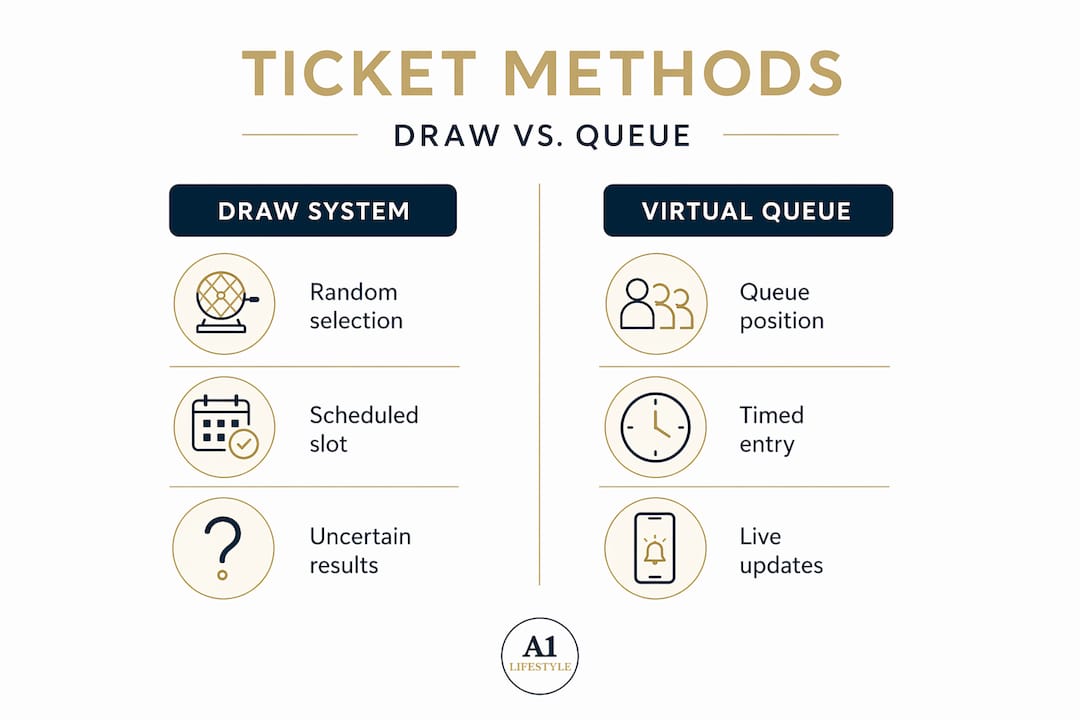
Each method has clear trade-offs. Draw systems spread opportunity fairly but introduce uncertainty. Virtual queues are fast but can feel opaque. Direct supporter allocation rewards loyalty but limits access to those outside recognised groups.
Draw and lottery systems explained
Draw-based allocation is the method used for the highest-demand events, and understanding the ticket allocation process here in detail is worth the effort.
The process typically follows these steps:
- Registration. The buyer creates an account and registers during a defined window. Registration confirms interest but does not secure a ticket or a purchase opportunity.
- The draw. After registration closes, organisers run a random selection. Those selected receive a time slot, which is their assigned window to purchase tickets.
- The purchase window. The time slot is the real deadline. As LA28 makes clear, missing your time slot means forfeiting the opportunity entirely, even if you were selected in the draw.
- Quantity limits. Most draw systems cap the number of tickets per purchaser to prevent bulk buying and keep access fair.
- Category downgrade consent. FIFA's system asks applicants whether they consent to receive a lower ticket category if their chosen category is unavailable. This consent applies to all tickets in the entry, with pricing adjusted accordingly.
- Payment authorisation. Successful applicants must complete payment within the purchase window. Failed payments result in the allocation being cancelled.
The category downgrade point is one that many buyers overlook. Agreeing to accept a lower category sounds like a minor concession, but it can mean a significant change in seat location and price. Read the consent terms carefully before submitting an entry.
Pro Tip: Set a calendar reminder the moment you receive your draw time slot notification. Treat it as a meeting with a hard start time. Organisers do not offer second chances if the window is missed.
Virtual queues and smart queue systems
Virtual queue systems manage the ticket allocation process for on-sale events where thousands of users attempt to access a platform simultaneously. The technology behind them is more deliberate than most buyers realise.

When a sale opens, the platform places users into a virtual waiting room. Each user receives an admission token, which controls when they are allowed to proceed to the ticket selection page. The Queue-it virtual waiting room system, used by major platforms, supports both first-in-first-out (FIFO) order and randomised admission, depending on how the organiser configures it.
This is where a common misconception costs buyers. Many assume that joining the queue the moment it opens guarantees a better position. In practice, queue order may be randomised to counter bots and distribute access more fairly. Eligibility checks, presale codes, and verified account status often carry more weight than the precise second at which a user clicked the link.
Key points to understand about virtual queue systems:
- Sign in to your account before the sale opens, not at the moment it starts.
- Presale codes and verified fan registrations grant access to separate, less congested queues.
- Bot prevention mechanisms mean that automated clicking tools actively harm legitimate users by triggering security checks.
- Refreshing the browser during a queue can reset your position on some platforms.
Pro Tip: Use a single device and a stable internet connection. Multiple tabs or devices on the same account can trigger eligibility flags that push you further back in the queue.
For exclusive drops and giveaway-based ticket access, platforms like winVIPtix operate their own queue and selection mechanics worth understanding if you are pursuing limited-release tickets.
Supporter allocation tiers and eligibility
A separate strand of how tickets are assigned at major football events involves supporter-specific allocation tiers. The FIFA World Cup 2026 introduced a Supporter Entry Tier priced at USD 60 to provide affordable access for fans of qualified nations.
The table below outlines the key differences between the two main supporter allocation categories:
| Feature | Supporter Entry Tier | Standard Random Draw |
|---|---|---|
| Price point | Fixed at USD 60 | Varies by category |
| Who controls allocation | Participating Member Association (PMA) | FIFA directly |
| Eligibility criteria | Set independently by each PMA | Open to all registered applicants |
| Inventory per nation | Limited, varies by association | Shared pool across all applicants |
| Refund for unsuccessful applicants | Yes, if not selected | Yes, if not selected |
The practical implication is significant. PMAs control their own inventory and define their own eligibility rules independently. A fan from one country may have a far higher or lower chance of receiving supporter tier tickets than a fan from another, simply because of the size of the allocation their association received and the criteria they apply.
Loyalty schemes, membership history, and prior attendance records all factor into how tickets are assigned through these channels. Buyers who have maintained active memberships with their national association for several years are generally prioritised over new registrants.
Practical tips for ticket buyers
Understanding the theory of ticket allocation strategies is useful. Applying that understanding at the point of purchase is what actually matters. The following guidance covers the most common points where buyers lose their opportunity.
- Register as early as possible. Draw systems do not reward late registration, but some platforms use registration data to verify account authenticity. An older, active account carries more credibility than one created the day before a sale.
- Treat your time slot as a hard deadline. A draw-assigned purchase window is not a suggestion. Missing it forfeits the opportunity regardless of how the registration process went.
- Read category downgrade consent terms before submitting. This applies to every ticket in the entry. Buyers who accept downgrade consent without reading the terms sometimes find they receive seats and prices they did not expect.
- Have payment details ready before the purchase window opens. Saved cards, verified billing addresses, and a clear checkout path reduce the time spent in the purchase window and lower the risk of a failed transaction.
- Manage expectations based on demand. For events with demand ten times the available supply, the majority of applicants will not receive tickets through official channels. Knowing this in advance allows buyers to plan alternative routes.
My perspective on ticket allocation
I have watched buyers make the same mistakes at major events for years. The most persistent one is the belief that speed is the deciding factor. It rarely is.
What I have seen actually matter is preparation. Buyers who read the rules before the sale opens, who have verified accounts, who understand what category downgrade consent means, and who treat their time slot as a genuine deadline consistently do better than those who simply try to click faster than everyone else.
The uncomfortable truth about draw systems is that they are genuinely random. A buyer who registers on day one of a window has the same chance as one who registers on the final day. That is by design. The LA28 approach of separating registration from purchase opportunity is a deliberate attempt to remove the advantage of being online at a specific second. Most buyers have not internalised this yet.
Category downgrades are the other area where I see consistent disappointment. Buyers consent to them without reading the implications, receive tickets in a lower category, and feel they were misled. The rules were clear. The issue was that the buyer did not read them.
Understanding how these systems work does not guarantee tickets. It does meaningfully improve the chances of using every legitimate opportunity correctly.
— Tony
Access tickets through A1 Lifestyle
The ticket allocation process at major events is complex, and for the most in-demand events, official channels alone are not always sufficient. A1 Lifestyle has over 30 years of experience securing access to sold-out events worldwide, including Premier League matches, VIP concert experiences, and Arsenal fixtures.
For buyers who have navigated official allocation systems without success, A1 Lifestyle provides a concierge route to confirmed access, VIP hospitality, and private boxes. The service covers the full range of sports events and entertainment, with a personalised approach that handles the complexity on the buyer's behalf. Whether the requirement is a single ticket or a full hospitality package, the A1 Lifestyle concierge team can advise on availability and options across the events calendar.
FAQ
What is ticket allocation?
Ticket allocation is the process by which event organisers distribute available tickets across buyers, groups, or channels. It includes draw systems, virtual queues, and supporter tier programmes, depending on the event.
How are tickets assigned in a draw system?
Buyers register during a set window, then a random draw assigns purchase time slots to selected registrants. Being selected in the draw gives access to a purchase window, not a guaranteed ticket.
Does joining a virtual queue earlier give a better position?
Not necessarily. Systems such as Ticketmaster's Smart Queue may use randomised admission rather than strict first-in-first-out order, meaning eligibility and account verification often matter more than the precise time of joining.
What does category downgrade consent mean in FIFA ticket draws?
It means the applicant agrees to accept a ticket in the next lower category if their chosen category is unavailable. This consent applies to all tickets in the entry, with pricing adjusted to reflect the lower category.
Why do allocation chances vary between supporters of different nations?
Each Participating Member Association controls its own inventory for supporter tier tickets and sets its own eligibility criteria independently. The size of each association's allocation and its selection rules differ, which creates variation in chances across nationalities.