

TL;DR:
- Executive entertainment packages are tailored experiences that align with event goals, audience, and budget to create impactful corporate events. Proper planning involves clear objectives, appropriate budget tiers, early booking, vendor vetting, and unified production teams to ensure seamless delivery. Immersive technologies require months of preparation, and neglecting these steps can lead to quality compromises or technical failures.
Executive entertainment packages are defined as curated hospitality experiences designed to meet the specific objectives, brand standards, and audience expectations of senior corporate events. To arrange executive entertainment packages successfully, planners must move well beyond booking a band or reserving a venue. The process involves aligning entertainment choices with event goals, managing multi-layered production logistics, and selecting the right tier of service for the audience. Pricing tiers range from Silver at £2,975+ per person through to ultimate VIP experiences starting at £16,100+ per person, reflecting the breadth of options available. The difference between a forgettable evening and a genuinely impactful event lies in how deliberately each element is chosen.
What are the key prerequisites for arranging executive entertainment packages?
Sound planning starts with three fixed inputs: a clear event objective, a defined audience profile, and a confirmed budget. Without these, every subsequent decision becomes guesswork.

Event objectives determine the entertainment style. A client appreciation dinner calls for a different atmosphere than a product launch or a leadership offsite. Planners who skip this step frequently book entertainment that feels disconnected from the event's purpose.
Budget tiers shape the scope of what is possible. Industry pricing structures typically follow four bands:
| Tier | Starting price per person | Typical inclusions |
|---|---|---|
| Silver | £2,975+ | Standard entertainment, basic AV, hosted bar |
| Gold | £6,500+ | Live acts, branded staging, dedicated host |
| Platinum | £10,500+ | Premium performers, full production, private dining |
| Superior | £16,100+ | VIP hospitality, private suites, behind-the-scenes access |
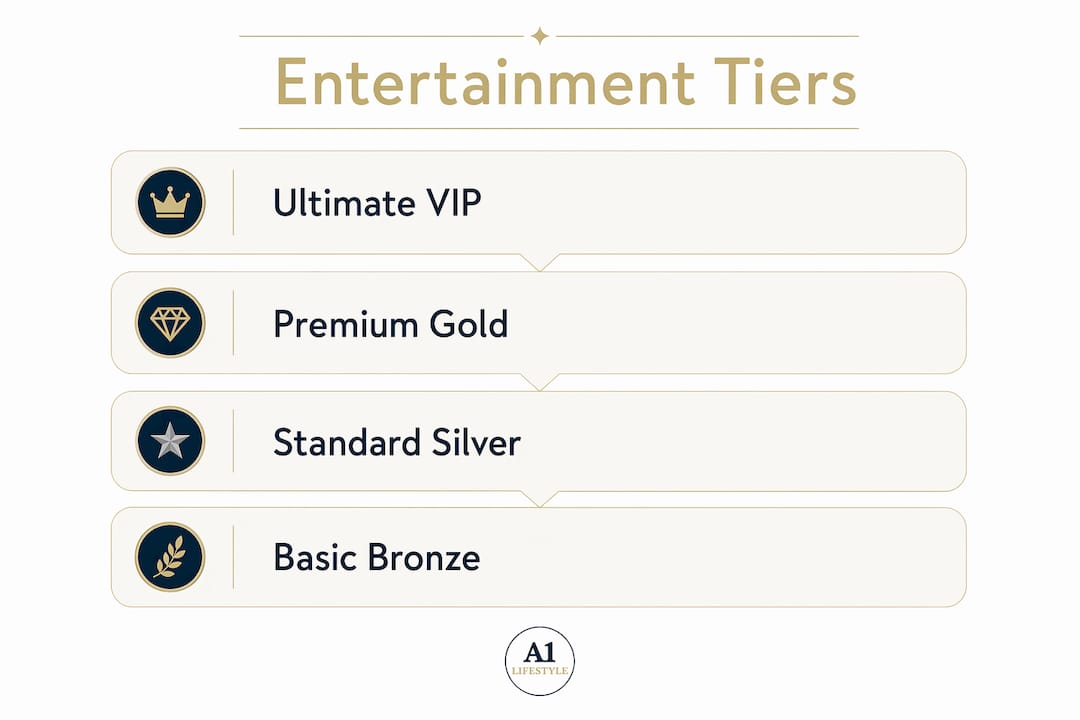
Each tier represents a different production scale, not just a price point. Moving from Gold to Platinum typically means adding a dedicated production manager and bespoke branding across all touchpoints.
Lead times are the most underestimated factor in business event planning. Standard live acts and DJ packages can be confirmed within a few weeks. Advanced immersive technologies such as holographic keynotes require 4–9 months of preparation, including content creation, technical testing, and rehearsals. Planners who leave immersive tech to the last quarter routinely compromise on quality or abandon the concept entirely.
- Confirm event objectives and audience profile before approaching any vendor
- Set a per-person budget and identify which tier it corresponds to
- Book standard entertainment at least 8–12 weeks out; immersive tech at 4–9 months
- Collect full technical riders from all performers before signing contracts
- Verify that the venue can accommodate the production requirements of the chosen tier
Pro Tip: Request a full technical rider from every act at the point of enquiry, not after signing. Riders reveal staging dimensions, power requirements, and crew needs that can make or break a venue choice.
How to select and customise executive entertainment options effectively
Entertainment selection is a consultative process, not a catalogue browse. Bespoke curation requires a detailed understanding of the client's vision, budget, and goals before a single act is approached. Generic selection produces generic results.
The most effective approach follows four stages:
-
Understand the brief. Gather information on brand culture, event theme, audience demographics, and the specific outcome the client wants. A financial services firm entertaining institutional clients has different needs from a tech company running an internal awards night.
-
Source with intent. Match entertainment options to the brief rather than defaulting to what is available. Options span traditional live bands and string quartets through to DJ and MC packages aligned to brand culture, and further into immersive formats such as holographic performances and hybrid digital experiences. The right entertainment format integrates brand messaging directly into the performance, which lifts engagement beyond passive watching.
-
Negotiate with full transparency. Confirm fees, technical requirements, exclusivity clauses, and cancellation terms before presenting options to the client. Surprises at contract stage damage trust and delay timelines.
-
Coordinate day-of logistics. Assign a named point of contact for each act and confirm call times, soundcheck windows, and changeover durations in writing. Verbal agreements at this stage are a consistent source of delays.
Audience demographics deserve particular attention. A room of senior executives aged 45–60 responds differently to entertainment than a mixed-age delegate audience. The entertainment must align with who is in the room, not just what the event theme suggests.
Corporate events regularly accommodate between 20 and 300+ attendees, and production scale must adjust accordingly. A 30-person private dinner requires intimate staging and low-volume performance. A 250-person gala demands full AV production, multiple lighting rigs, and a stage large enough to hold the act comfortably.
Pro Tip: When balancing team-building objectives with entertainment, choose participatory formats such as interactive music workshops or hosted game experiences rather than purely passive performances. Participation drives connection more reliably than observation.
What logistical steps ensure smooth delivery of executive entertainment packages?
Flawless execution depends on treating performers and technical teams as a single production unit. Unified entertainment and AV teams reduce technical delays and eliminate the sound gaps that disrupt critical moments such as award presentations or executive speeches.
The core logistical steps are:
- Produce a detailed run-of-show document that maps entertainment against every event transition, including speeches, networking breaks, and dining courses
- Assign a dedicated on-site production manager who holds authority to make real-time decisions without escalating to the client
- Conduct a full technical rehearsal at the venue, not just a soundcheck, to test lighting cues, AV transitions, and performer entrances
- Build contingency windows of at least 15 minutes into the run-of-show for each major entertainment segment
- Confirm that dedicated on-site support is available throughout the event for both technical and concierge issues
AV production, lighting design, and sound engineering must be coordinated as a single brief, not sourced separately. Planners who use three different vendors for these three functions create communication gaps that surface at the worst possible moment.
"The production architecture surrounding an act, including AV integration and contingency planning, is what determines success. Talent alone is not enough. Every technical element must be rehearsed, tested, and assigned to a named owner before the first guest arrives."
Risk mitigation is a fixed part of the production plan, not an afterthought. Identify the two or three scenarios most likely to cause disruption, such as a performer running late or an AV failure, and document the response protocol for each before the event day.
What are common mistakes when arranging executive entertainment packages?
The most costly mistakes in premium event arrangements share a common cause: insufficient planning time. Correcting them after the fact is expensive and often impossible.
-
Underestimating lead times for immersive technology. Immersive tech needs 4–9 months for content creation and testing. Planners who treat holographic or hybrid formats like standard bookings consistently face quality compromises or last-minute cancellations.
-
Failing to align entertainment with event goals. Entertainment chosen without reference to the event's strategic purpose feels like a distraction rather than a contribution. Every act, format, and performance moment should connect back to the event objective.
-
Inadequate vendor vetting. Reviewing a showreel and checking availability is not due diligence. Planners should verify insurance, confirm previous corporate event experience, and speak directly with references from comparable events before signing any contract.
-
Ignoring technical rider details. A performer's technical rider is a contractual document. Failing to meet its requirements can result in a reduced performance, a cancelled set, or a venue penalty. Read every rider in full and confirm venue compliance before booking.
-
Treating entertainment as the last item on the planning list. Entertainment affects venue choice, catering timing, AV specification, and staffing levels. It belongs at the top of the planning agenda, not the bottom.
Pro Tip: Build a vendor communication log from day one. Record every conversation, decision, and confirmation in writing. When something goes wrong on event day, a clear paper trail resolves disputes in minutes rather than hours.
Key takeaways
Arranging executive entertainment packages requires defined objectives, tiered budget planning, and unified production management to deliver events that meet senior-level expectations.
| Point | Details |
|---|---|
| Define objectives first | Confirm event goals and audience profile before approaching any entertainment vendor. |
| Match budget to tier | Silver to Superior pricing tiers reflect production scale, not just cost. |
| Plan lead times carefully | Immersive tech requires 4–9 months; standard acts need 8–12 weeks minimum. |
| Unify production teams | Treat performers and AV crews as one unit to eliminate technical gaps. |
| Vet vendors thoroughly | Check insurance, corporate references, and technical riders before signing contracts. |
What I have learned from planning executive entertainment at scale
The most persistent misconception I encounter is that executive entertainment is primarily about the act. Planners spend weeks debating which performer to book and then allocate two days to production logistics. That ratio is backwards.
The production architecture, meaning the AV integration, the run-of-show discipline, the contingency planning, determines whether an event feels polished or patched together. I have seen world-class performers deliver underwhelming experiences because the sound was poorly calibrated or the lighting cues were missed. I have also seen mid-tier acts deliver genuinely memorable moments because every technical element was rehearsed and owned.
The shift that changes everything is moving from "what entertainment shall we book" to "what experience do we want to create, and what production is required to deliver it." That reframe changes every subsequent decision, from venue selection to staffing ratios to timeline construction.
On the question of immersive technology: the 2026 appetite for holographic and hybrid formats is real, but the planning discipline required to execute them well is still underestimated. Immersive formats cost 1.5–3 times more than standard high-end entertainment and require months of preparation. They are worth it when the brief demands them. They are a liability when booked to impress rather than to serve the event's purpose.
My consistent advice to planners: engage your entertainment partner at the same time you engage your venue. Not after. At the same time.
— Tony
How A1lifestyle supports bespoke executive entertainment
A1lifestyle has over 30 years of experience arranging exclusive access to high-profile events for corporate clients and executives. The service covers VIP hospitality, private boxes, and personalised concierge support across sports, music, and cultural events worldwide.
For corporate planners seeking Premier League hospitality or access to major sporting occasions through the sports events calendar, A1lifestyle provides confirmed access to sold-out events alongside dedicated support from enquiry through to the day itself. Packages are tailored to group size, budget, and the specific objectives of each corporate booking. The team handles logistics, access, and on-the-day coordination so planners can focus on their guests rather than their run-of-show. Contact A1lifestyle directly to discuss requirements for your next executive event.
FAQ
What does it cost to arrange executive entertainment packages?
Pricing tiers range from approximately £2,975 per person at Silver level to £16,100+ per person for ultimate VIP experiences including private suites and behind-the-scenes access. The tier selected determines the production scale, not just the entertainment quality.
How far in advance should executive entertainment be booked?
Standard live acts and DJ packages require a minimum of 8–12 weeks. Immersive technologies such as holographic performances require 4–9 months of lead time for content creation, technical testing, and rehearsals.
What is consultative curation in executive entertainment?
Consultative curation is a four-stage process covering understanding the client brief, sourcing matched acts, negotiating contracts, and coordinating day-of logistics. It replaces generic act selection with a tailored approach aligned to brand culture and event objectives.
Why do unified production teams matter for executive events?
Unified entertainment and AV production teams reduce the risk of technical delays and sound gaps during critical event moments. Sourcing AV, lighting, and performers separately creates communication gaps that typically surface during the event itself.
What are the most common mistakes in planning luxury entertainment packages?
The most frequent errors are underestimating lead times for immersive technology, failing to align entertainment with strategic event goals, and ignoring technical rider requirements. Each of these is preventable with earlier planning and thorough vendor vetting.