

TL;DR:
- A concierge secures reservations that the public cannot by accessing held-back inventory through direct venue relationships. Success relies on early requests, flexible options, and timely follow-ups within institutional channels and relationship networks. Effective briefing, realistic timelines, and choosing experienced providers maximize the chance of securing exclusive access.
A concierge converts a sold-out listing into a confirmed booking by accessing held-back inventory, leveraging direct relationships with venue decision-makers, and running active follow-up cycles that the public cannot replicate. Three tactics underpin almost every success:
- Use institutional channels first. Hotel concierges and premium credit-card desks hold verified inventory allocations that never reach public booking platforms.
- Allow seat and time flexibility. Counter seating, bar positions, and off-peak slots (Tuesday to Thursday, before 17:30 or after 21:00) carry materially higher availability than prime weekend dinner slots.
- Authorise late follow-ups. A two-pronged approach, early request plus a targeted sweep 48–24 hours before the date, captures last-minute cancellations and released VIP holds that most clients miss.
A1lifestyle provides this service directly for premium concerts, sports events, and shows. See the promo section for the next steps.
Table of Contents
- How does a concierge secure reservations the public cannot?
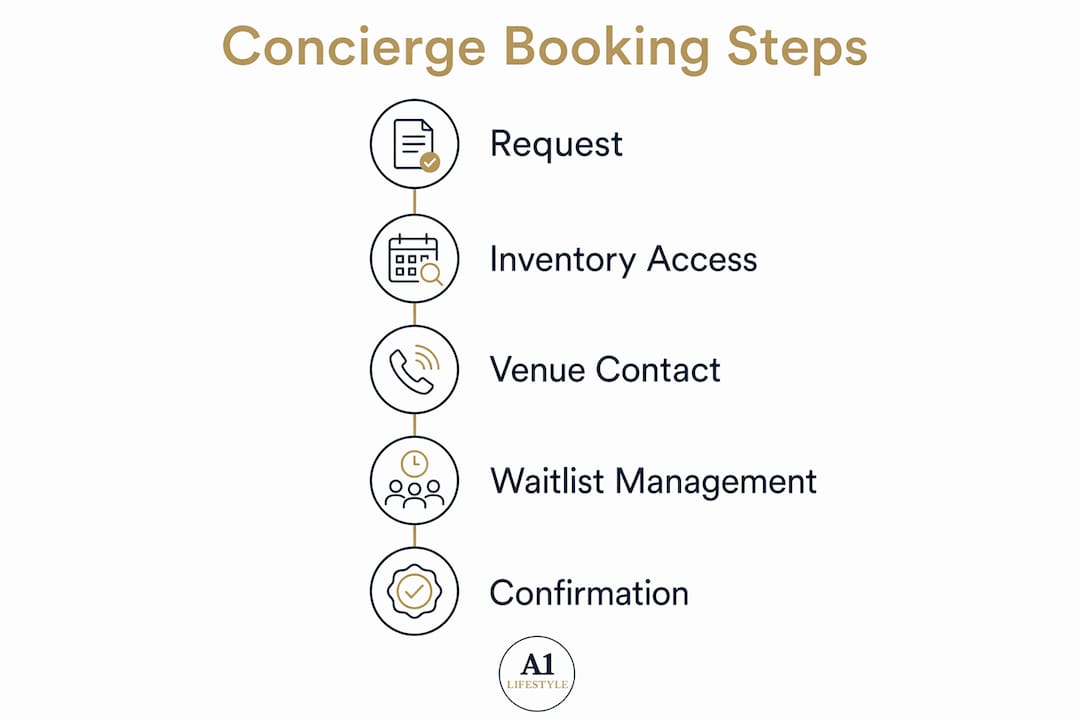
- What is the step-by-step concierge playbook?
- What timelines and costs should you expect in the UK?
- How should you brief a concierge to maximise success?
- How do you choose the right concierge and spot weak providers?
- Case studies: tactics in action
- Key takeaways
- What the playbook misses
- A1lifestyle concierge services for VIP access
- FAQ
How does a concierge secure reservations the public cannot?
Concierges do not create seats. They access inventory that venues deliberately withhold from public booking channels, then use relationship capital and timing knowledge to claim it.
Venues reserve a portion of their capacity for high-value, recurring channels: hotel concierge desks, premium credit-card programmes, and long-standing corporate accounts, leveraging concepts similar to exclusive access in yacht rentals where privileged inventory is held back for select clients. This inventory never appears on Resy or OpenTable. Top concierges reach it through private messaging APIs and dedicated phone lines that connect directly to a restaurant host or venue manager, bypassing the public booking queue entirely.
For invitation-only counters and private dining clubs, online systems are bypassed completely. Access depends entirely on relationship capital between veteran concierges and venue managers. No app replicates that.
Active waitlist management adds a second layer. Concierges track exact release cycles for house tables, sometimes acting within a 24-hour window, and poll booking APIs at intervals of 30–60 seconds to catch cancellations before they are visible to the general public.
| Access channel | Typical access level | Speed | Reliability |
|---|---|---|---|
| Hotel/card allocation | High (held inventory) | Immediate on request | High for verified partners |
| Direct relationship (GM/host) | Very high (off-menu inventory) | Same-day possible | High, relationship-dependent |
| Active waitlist/polling | Moderate (cancellations) | Hours to days | Moderate |
| Third-party reservation services | Low to moderate | Variable | Lower, no institutional pull |
What is the step-by-step concierge playbook?
A structured sequence separates concierges who succeed consistently from those who do not.
- Submit the request early. For high-demand dining rooms, submit at least 30 days out. For VIP boxes and premium concert packages, 60–90 days is standard. Early requests capture standard allocation inventory before it is distributed.
- Build account history. Some venues use algorithmic release systems that favour profiles with prior bookings. A concierge with an established account at a venue carries more weight than a first-time request.
- Authorise follow-ups in writing. Give the concierge explicit permission to act on your behalf for updates, alternative dates, and last-minute charges. This removes friction at the critical moment.
- Target the 7–14 day window. Many venues release held tables or adjust allocations in this window. A concierge who tracks these cycles can time a follow-up call or message to coincide with a release.
- Run a 48–24 hour sweep. Cancellations concentrate in the final two days. A targeted sweep at this stage captures released VIP holds and house tables that were unavailable earlier.
- Offer flexible alternatives. Counter seating, bar positions, and weekday lunch slots show materially higher availability. Authorising these options in advance doubles the concierge's working options.
Pro Tip: When briefing a concierge, offer at least three alternative times across a Tuesday-to-Thursday window. A concierge with multiple options can often secure one of them within 24 hours, even for rooms that appear fully booked online.
For concerts and sports events, the same logic applies. Sold-out show access often depends on VIP package releases in the 14-day window before the event.
Hotel and credit-card concierges hold institutional allocations that most third-party services cannot match. However, third-party services with documented venue relationships can outperform a hotel desk for niche or specialist venues outside the hotel's network.
What timelines and costs should you expect in the UK?
Timelines vary by reservation type. Popular dining rooms with algorithmic drops typically require about a month of lead time for a realistic chance at prime slots. Tasting counters and chef's table formats, which release fewer covers, need significantly longer lead times. VIP boxes and premium concert packages work on longer cycles, often several months in advance, though last-minute packages do surface.
Typical cost structures in the UK market:
- Flat concierge fee. A fixed charge per successful booking, regardless of the reservation value. Common for dining concierge services.
- Service surcharge. A percentage added to the face value of tickets or packages. Standard for VIP event access.
- Commission or markup. Applied to the total package value, disclosed at the point of confirmation. A1lifestyle operates on this model for event and hospitality bookings.
- Deposit on account. Some services require a holding deposit, refundable if the request is unsuccessful. Clarify the refund terms before authorising.
Success-rate expectations by channel:
- House table releases (tracked release cycles): high success rate when the concierge has documented access to that venue's cycle.
- Card/hotel allocations: reliable for partner venues; limited outside the network.
- Last-minute cancellation capture: moderate, higher when the client has authorised flexible alternatives.
- Invitation-only or private dining: dependent entirely on relationship capital; no guarantee is realistic.
How should you brief a concierge to maximise success?
The quality of the brief directly affects the outcome. A concierge acting on incomplete information cannot use the full range of available channels.
Information to provide at the outset:
- Exact dates, preferred times, and party size.
- Dietary requirements, accessibility needs, and seating preferences.
- Acceptable alternative dates, times, and seat types.
- Payment authorisation details and spending limit for last-minute charges.
- A direct contact number for urgent confirmations.
Questions to ask the concierge before engaging:
- Which specific channels will you use for this request?
- How often will you update me, and by what method?
- What is your cancellation and refund policy if the request fails?
- Are there additional charges for follow-up attempts?
Written authorisation should state the date range, the maximum spend the concierge may commit to without further approval, and the acceptable seat or ticket types. Keep it brief and specific.
Pro Tip: Authorise a modest holding charge in advance, for example a deposit up to a stated amount, with a clear revocation notice period. This lets the concierge act immediately when a last-minute slot opens, without waiting for approval that could cost the booking.
Client demeanour matters more than most clients expect. Concierges will prioritise requests from clients who are straightforward and easy to work with. Being demanding or inflexible reduces the concierge's ability to advocate effectively on your behalf.
How do you choose the right concierge and spot weak providers?
Selection checklist:
- Verified hotel or card network affiliations with named partner venues.
- Documented direct relationships with venue managers or GMs.
- Transparent, written fee schedules provided before engagement.
- References or anonymised case results available on request.
- Clear written cancellation and refund policy.
Red flags:
- Vague promises of access with no explanation of the channels used.
- Refusal to name the venues or networks they have access to.
- No written fee schedule or insistence on cash-only payments.
- No clear refund policy if the request is unsuccessful.
- Pressure to commit a large deposit before any details are confirmed.
Trust signals to request:
- Anonymised case results showing the tactic used and the outcome.
- Named venue contacts where the relationship is established (appropriate for high-value requests).
- A clear escalation route if the primary contact is unavailable.
For exclusive event access, the concierge should be able to describe the specific channel they will use for your request, not just state that they have "connections."
Case studies: tactics in action
Case study 1: Tasting counter, London
A client requested a two-cover booking at a London tasting counter with a six-week waiting list. The public booking system showed no availability for three months. A1lifestyle identified the venue's house table release cycle and submitted a targeted request 72 hours before the client's preferred date. A cancellation surfaced within the release window. The booking was confirmed at face value, two covers at the counter, for the original date.
Case study 2: VIP box, Premier League fixture
A corporate client needed four seats in a private box for a Premier League fixture with 18 days' notice. Standard hospitality packages were sold out. A1lifestyle accessed a held allocation through an institutional channel, confirmed the package within 48 hours, and arranged pre-match catering as part of the booking. The client received written confirmation with full cost disclosure before committing.
In both cases, success depended on knowledge of release cycles and access to held inventory, not on luck or volume of requests.
Key takeaways
A concierge secures impossible reservations by combining held-back inventory access, direct venue relationships, and a two-pronged timing strategy of early requests plus targeted late follow-ups.
| Point | Details |
|---|---|
| Prioritise institutional channels | Hotel and card allocations hold inventory the public never sees; use these first. |
| Offer flexible alternatives | Counter seating and weekday slots outside peak times increase availability. |
| Brief in writing | Provide dates, party size, alternatives, and a pre-authorised spend limit before the concierge acts. |
| Expect realistic timelines | Dining rooms need 28–30 days; VIP boxes and concerts need 60–90 days for best results. |
| Use A1lifestyle for VIP access | A1lifestyle provides concierge services for sold-out concerts, sports events, and shows via its services page. |
What the playbook misses
Most guides focus on the mechanics of booking and ignore the advocacy layer. A concierge's value is not just speed or channel access. It is the ability to frame a request in terms that serve the venue's interest, not just the client's. Effective concierge advocacy positions the guest as a reliable, high-value presence rather than a one-time transaction. That framing is what separates a successful call to a GM from a polite refusal.
The other underestimated factor is client behaviour. Concierges allocate their best efforts to clients who are easy to work with and who authorise reasonable follow-up charges in advance. A demanding brief, or one that restricts every option, limits what the concierge can do at the critical moment. The clients who get the hardest bookings are usually the ones who give the most latitude, not the most pressure.
After 30 years in this industry, the pattern is consistent: the request that succeeds is rarely the loudest one. It is the one that arrives early, with clear authorisation, and with enough flexibility for the concierge to act when the window opens.
A1lifestyle concierge services for VIP access
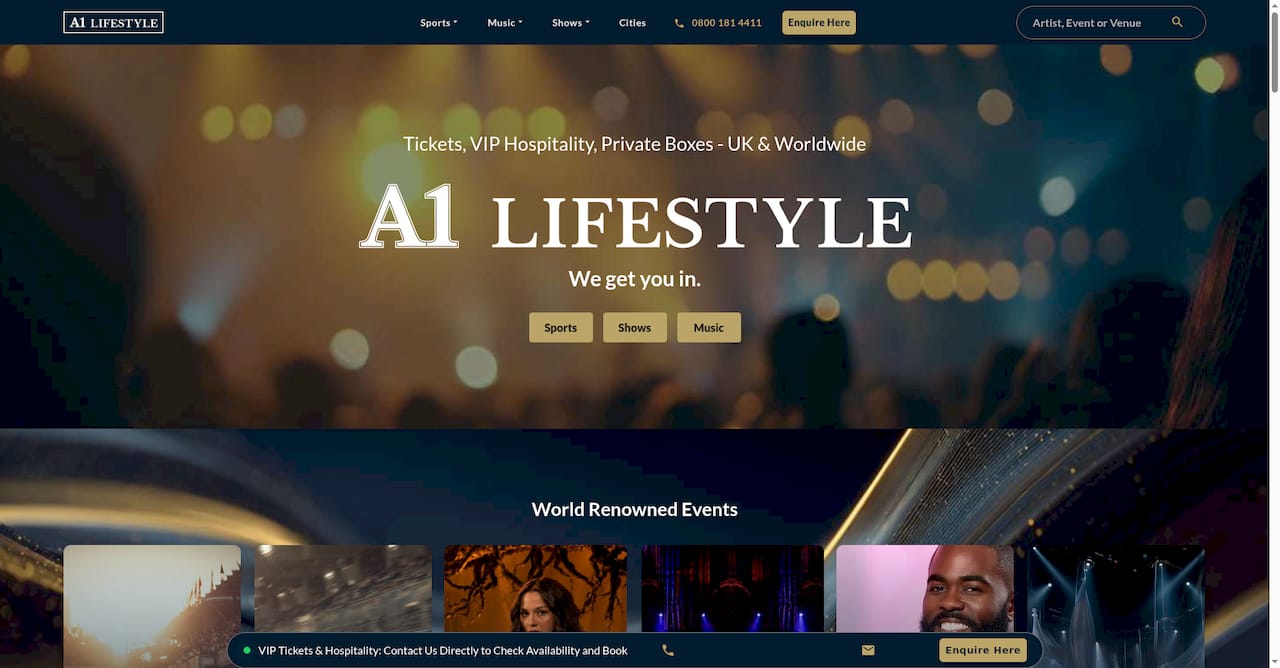
A1lifestyle provides direct concierge access to sold-out concerts, sports events, private boxes, and premium shows worldwide. The service operates on a transparent commission and markup model, with full cost disclosure before any booking is confirmed. Turnaround for standard requests is 24–48 hours; urgent requests are handled on the same day where inventory allows.
For VIP concert packages, Premier League hospitality, and F1 event access, the team uses the institutional channels and venue relationships described in this article. There are no hidden fees and no cash-only arrangements.
To enquire, visit the A1lifestyle services page, select the event or experience, and submit a request with your preferred dates and party size. For urgent requests within 48 hours of an event, contact the team directly via the services page for immediate handling.
FAQ
How far in advance should a concierge request be submitted?
For dining rooms, about a month is typical lead time for prime slots. VIP boxes and premium concert packages generally require several months’ advance notice, though last-minute packages do become available closer to the event date.
Do hotel concierges outperform third-party reservation services?
Hotel and premium credit-card concierges generally hold verified inventory allocations that third-party services cannot access. For venues outside a hotel's partner network, a specialist third-party service with documented relationships may perform better.
What information does a concierge need to act quickly?
Provide the date, party size, acceptable alternatives, dietary requirements, and a pre-authorised spend limit. Written authorisation covering these details allows the concierge to confirm a last-minute booking without waiting for approval.
How does A1lifestyle handle fee disclosure?
A1lifestyle operates on a commission and markup model with full cost disclosure before any booking is confirmed. No charges are committed without prior written authorisation from the client.
Can a concierge secure access to invitation-only venues?
For invitation-only counters and private dining clubs, access depends entirely on direct relationship capital between the concierge and venue management. A1lifestyle's concierge services cover this category for clients with established accounts.