

TL;DR:
- Joining a ticket waitlist does not guarantee available tickets, as availability depends on cancellations or extra releases.
- Waitlist positions are often randomised after closing, so early registration does not necessarily improve chances.
Joining a waiting list for a sold-out event sounds straightforward. Many people assume it works like a simple queue: first in, first served, and a ticket is practically guaranteed. That assumption leads to disappointment. Understanding what is a ticket waiting list, how it actually functions, and what you can realistically expect from the process is far more useful than wishful thinking. This guide covers how a waitlist for tickets operates, the rules that govern them, how they differ from other ticketing systems, and what you can do to improve your chances.
Table of Contents
- Key takeaways
- What is a ticket waiting list and how does it function?
- Rules and behaviour of ticket waitlists
- Ticket waitlists versus other queue systems
- Making the most of a ticket waiting list
- Ticket waiting list systems in practice
- My perspective on ticket waiting lists
- How A1 Lifestyle can help with sold-out events
- FAQ
Key takeaways
| Point | Details |
|---|---|
| No guaranteed tickets | Joining a waitlist does not guarantee a ticket; availability depends on cancellations or extra releases. |
| Order is not always priority | Many organisers randomise waitlist entries after closing, so submitting early may not improve your position. |
| Prompt response is required | Users typically receive a short purchase window, often around 15 minutes, to buy an offered ticket. |
| Declining costs you position | On membership-style waitlists, declining a ticket offer can move you to the bottom of the list. |
| Alternative access exists | Concierge services and specialist ticket providers can offer access to sold-out events outside the standard waitlist process. |
What is a ticket waiting list and how does it function?
A ticket waiting list, also referred to in the industry as a waitlist or standby queue, is a registration system used when an event has sold out. Waitlists maximise attendance by filling seats freed through cancellations or additional ticket releases, notifying registered fans when those seats become available.
The process works as follows. A user registers their interest with the event organiser or ticketing platform after the event has sold out. Their details, including contact information, account data, and the time they joined the list, are stored in the system. When a ticket becomes available, because another buyer cancelled or the organiser released additional inventory, the system identifies eligible users and sends a notification.
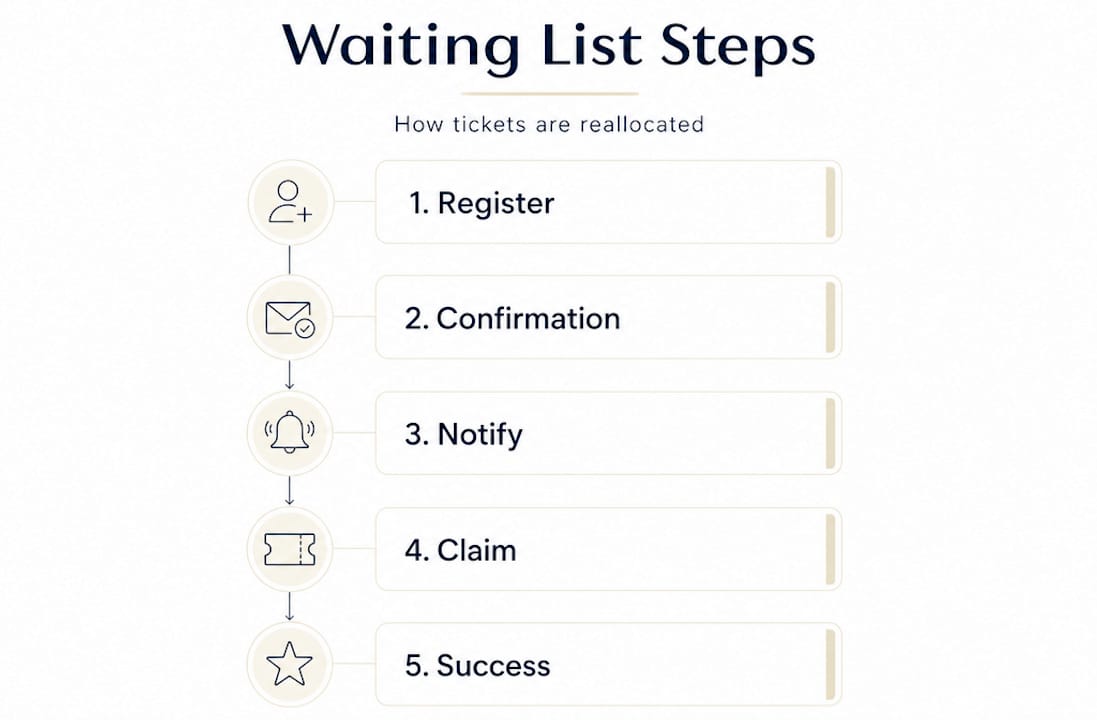
The technical side of this is fairly precise. Systems such as those used by major ticketing platforms store event IDs, user IDs, and timestamps to track each waitlisted user. When a reserved seat expires or an order is cancelled, the next eligible user receives a notification and a limited-time purchase window, typically around 15 minutes, to complete their purchase.
Waiting lists appear across many different event types. Football clubs use them for season tickets. Music festivals use them for general admission and VIP packages. Theatre productions, fan conventions, and sporting tournaments all operate similar systems. The principle is consistent: register interest, wait for availability, act quickly when notified.
Pro Tip: Read the confirmation page carefully when you register for a waitlist. It usually states whether your position is based on registration time or whether entries will be randomised after a closing date. These are two very different processes.
It is also worth noting that waiting list principles apply broadly across reservation systems, from Indian Railways to sold-out concerts. The underlying logic is the same: use unfilled capacity and notify interested parties efficiently.
For a broader look at how organisers manage high demand, the guide to ticket allocation strategies explains the full picture.
Rules and behaviour of ticket waitlists
This is where most people get caught out. The rules governing a waitlist for tickets vary considerably between events and organisers. A few principles apply consistently, but the specifics matter.
Here are the most important rules to be aware of:
- Joining does not guarantee a ticket. Availability is often extremely limited and offers are selective. Waitlist membership gives you a chance, not a certainty.
- Submission time may not determine your position. Many organisers randomise waitlist entries after closing, meaning someone who registered on the last day has an equal chance as someone who registered on the first day.
- Declining an offer has consequences. On membership-style waitlists, such as those used by football clubs, declining a ticket offer can move you to the bottom of the list. Celtic FC, for example, states this policy explicitly to discourage registrations from users who are not genuinely committed.
- Purchase windows are short. Once notified, you typically have a fixed amount of time to complete your purchase. Missing this window usually means the ticket moves to the next person on the list.
- Contact details must be current. If the notification goes to an outdated email address or a phone number you no longer use, the offer passes to the next user.
"Waitlist membership provides no guarantee of ticket availability due to extremely limited capacity. Notification is selective and not based solely on registration order." — D23 Ultimate Fan Event Terms
There is also a distinction between open waitlists and membership-style waitlists. Open waitlists allow any member of the public to register. Membership-style waitlists, common in sports clubs, require the user to hold an existing membership or meet specific eligibility criteria before they can join. The exclusive event access model often follows this membership approach.
Ticket waitlists versus other queue systems
A common source of confusion is the difference between a ticket waiting list and a virtual waiting room. They sound similar but serve completely different purposes.
| System | When it operates | Purpose | Position basis |
|---|---|---|---|
| Virtual waiting room | Before tickets go on sale | Controls traffic to prevent server overload | Assigned when sale opens |
| Post-sellout waiting list | After event sells out | Fills cancellations and extra releases | Registration time or randomised |
| General queue | During active sale | Manages purchase order | Real-time queue position |
A virtual waiting room is a pre-sale traffic management tool. Ticketmaster uses Queue-it technology to assign users a position before the sale opens and control how many people access the purchase page simultaneously. This prevents the system from crashing and reduces bot interference.
A post-sellout waiting list operates independently of the sale itself. The BBC Radio 1 Big Weekend uses a Ticketmaster virtual waiting room before tickets go on sale, which is separate from any waiting list used after tickets sell out. Users sometimes conflate the two because both involve waiting, but the mechanics and the outcomes are different.
Pro Tip: If you are in a virtual waiting room before a sale opens, your position is live and active. If you are on a post-sellout waitlist, you are in a passive registration system with no real-time movement. Managing your expectations for each requires a different approach.
Understanding how ticket allocation works across these different systems helps you decide where to focus your effort when chasing tickets for high-demand events.
Making the most of a ticket waiting list
Registering for a waitlist is a passive action. What you do before and after that registration determines whether it pays off.
- Register as early as possible, but understand its limits. Even when order does not affect priority, registering early means you will not miss a closing date. Some waitlists close quickly after selling out.
- Keep your account and contact details updated. Ticketmaster and other platforms emphasise this point. An outdated email address means a missed offer.
- Respond immediately to any notification. Purchase windows are short. Set up notifications on your phone or email so you do not miss the alert.
- Read the event-specific terms. Every organiser sets their own rules. The difference between a randomised list and a chronological one is significant, and it affects your strategy. Theatre ticket systems, for example, have their own booking conventions as outlined in this guide to Oxford theatre tickets.
- Consider alternatives alongside the waitlist. A waitlist is one route, not the only one. Concierge services, resale platforms, and specialist event access providers offer routes to sold-out events outside the standard ticket reservation system.
- Do not decline an offer unless you are certain. On membership-style waitlists, a declined offer can cost you months or years of progress through the list.
Use the event ticket purchase checklist to make sure you have covered every step before and after joining a waitlist.
Ticket waiting list systems in practice
Real-world examples make the process clearer. Here is how several well-known events and platforms handle their waitlists.
| Event or platform | Waitlist type | Key feature |
|---|---|---|
| Celtic FC season tickets | Membership-style | Declining an offer moves you to the bottom of the list |
| D23 Ultimate Fan Event | Randomised open waitlist | Submission order has no effect on priority after closing |
| BBC Radio 1 Big Weekend | Pre-sale virtual queue | Separate from any post-sellout registration process |
| Ticketmaster | Automated notification | 15-minute purchase window when a ticket becomes available |
Celtic FC's approach is one of the most structured examples in British and European football. Eligible members receive notification for the 2026/27 season ticket waitlist, and the policy around declining offers is communicated clearly. This encourages only committed fans to hold a position.

The D23 Ultimate Fan Event takes a different approach. Because demand is high and the audience is global, waitlist entries are randomised after closing. This is explicitly stated in their terms to manage expectations. Many users do not realise this until after the fact, which is why reading terms upfront matters.
Ticketmaster's system sits at the technical end of the spectrum. Automated tools track expiring reservations and notify the next user in the queue within seconds of a ticket becoming available. The purchase window is fixed and non-negotiable. Large events increasingly rely on predictive systems and automated notifications to fill every available seat.
My perspective on ticket waiting lists
I have spent a long time watching how people approach ticketing for sold-out events, and the same mistake comes up repeatedly. Users join a waitlist and then treat it as a done deal. They stop looking for alternatives. They do not update their contact details. They miss the 15-minute window because they were not watching their inbox.
In my experience, a waitlist is best treated as a background option rather than a primary strategy. The randomisation factor alone should shift your thinking. I have seen fans who registered weeks before others receive a ticket offer, while early registrants received nothing. The D23 example is not an outlier. Many major events use randomisation precisely because it is fairer at scale.
What I have found to be consistently true is that reading the specific terms for each event is the single most useful thing a user can do. The difference between how Celtic FC manages its list and how D23 manages theirs is substantial. Treating every waitlist as identical is the main reason people are caught off guard.
My practical advice is to join the waitlist, then pursue at least one other route in parallel. A specialist concierge service with direct industry relationships will often secure access faster than a public queue. For major events, that parallel approach is not a backup plan. It is the sensible one.
— Tony
How A1 Lifestyle can help with sold-out events
If a ticket waiting list has not delivered results, A1 Lifestyle offers a direct alternative. With over 30 years of industry expertise and a global network of event contacts, A1 Lifestyle secures access to sold-out events including Premier League matches, VIP concerts, and major festivals such as EXIT Festival. The service includes VIP hospitality, private boxes, and personalised concierge support. Rather than waiting for a notification that may never arrive, clients work directly with a team that has existing relationships with venues and organisers. Visit A1 Lifestyle's concierge services to find out what is currently available.
FAQ
What does a ticket waiting list mean?
A ticket waiting list is a registration system that records interest from users after an event has sold out. Users are notified if tickets become available due to cancellations or additional releases.
How does a waiting list work for tickets?
When a ticket becomes available, the system notifies eligible users in order of their position on the list. The notified user typically receives a short window, often around 15 minutes, to complete a purchase before the offer moves to the next person.
Does joining a waitlist guarantee a ticket?
No. Joining a waitlist provides no guarantee of receiving a ticket. Availability is limited and depends entirely on cancellations or extra releases from the organiser.
Does registering first improve your chances?
Not always. Some organisers, such as the D23 Ultimate Fan Event, randomise waitlist entries after closing, so the time of submission has no effect on your position.
What is the difference between a virtual queue and a waiting list?
A virtual queue manages traffic before and during an active ticket sale. A waiting list is used after an event has sold out. They are separate systems with different purposes and different outcomes for the user.