

TL;DR:
- VIP hospitality focuses on personalized experiences to deepen relationships with high-value clients and drive measurable business outcomes. These experiences accelerate decision-making, shorten sales cycles, and foster client loyalty by creating memorable and tailored interactions. Effective VIP programs are focused, personalized, and integrated with broader marketing efforts to generate long-term value.
VIP hospitality is defined as a structured programme of exclusive access, personalised service, and friction removal designed to deepen relationships with high-value clients and stakeholders. The case for investing in these experiences is not about luxury for its own sake. It is about measurable commercial outcomes: faster sales cycles, stronger client retention, and competitive differentiation that competitors cannot replicate by adjusting a price point. Understanding why businesses invest in VIP experiences requires looking at the data behind client engagement, not just the optics of premium treatment.
McKinsey's 2023 buyer behaviour research confirms that live interaction accelerates enterprise decision-making late in the sales cycle. Digital touchpoints dominate early-stage outreach, but they rarely close complex deals. VIP live experiences fill that gap by creating the conditions for trust to form quickly. For business leaders managing long, multi-stakeholder sales processes, that acceleration has direct financial value.
Why businesses invest in VIP experiences: the sales case
The commercial argument for VIP investment is grounded in account concentration. ABM research shows that 1–5% of accounts regularly contribute 60–80% of revenue in complex sales environments. That concentration means securing a meeting with a handful of key decision-makers can justify significant investment in a single event or experience.
Enterprise exhibitors using structured VIP strategies at trade shows report higher meeting conversion rates and noticeably shorter sales cycles compared to standard outreach. The mechanism is straightforward: a curated environment removes distractions, signals respect for the client's time, and creates a context where substantive conversation is possible. That is difficult to replicate in a standard meeting room or a generic hospitality tent.
The benefits of VIP services extend beyond the event itself. Clients who experience well-executed VIP treatment associate that quality of attention with the business providing it. That association carries into procurement decisions, contract renewals, and referrals. The return on a single well-placed VIP experience can compound across multiple revenue cycles.
Pro Tip: Personalise every VIP touchpoint to a specific client's interests rather than applying a standard package. A client who follows Premier League football responds differently to stadium hospitality than to a generic corporate dinner.
What separates VIP from standard client engagement?
The difference between VIP and standard client engagement is not price. It is the removal of friction and the presence of genuine personalisation. Standard engagement asks the client to adapt to the business's schedule, venue, and format. VIP engagement does the opposite.

VIP services coordinate complex logistics to preserve executives' schedules and reduce stress. The real value is predictability and frictionless navigation, not luxury for its own sake. A senior decision-maker who arrives at an event without queuing, without confusion, and with their preferences already anticipated is in a far more receptive state than one who has spent an hour navigating a crowded venue.
The table below shows how VIP engagement differs from standard client interactions across the dimensions that matter most to business outcomes.
| Dimension | Standard engagement | VIP engagement |
|---|---|---|
| Logistics | Client manages own travel and access | Business coordinates all logistics end to end |
| Personalisation | Generic agenda or format | Tailored to client's specific interests and preferences |
| Environment | Shared, often noisy or crowded | Private, controlled, and distraction-free |
| Emotional impact | Transactional | Memorable and relationship-building |
| Competitive defensibility | Low. Easily matched by rivals | High. Experiences are difficult to replicate |
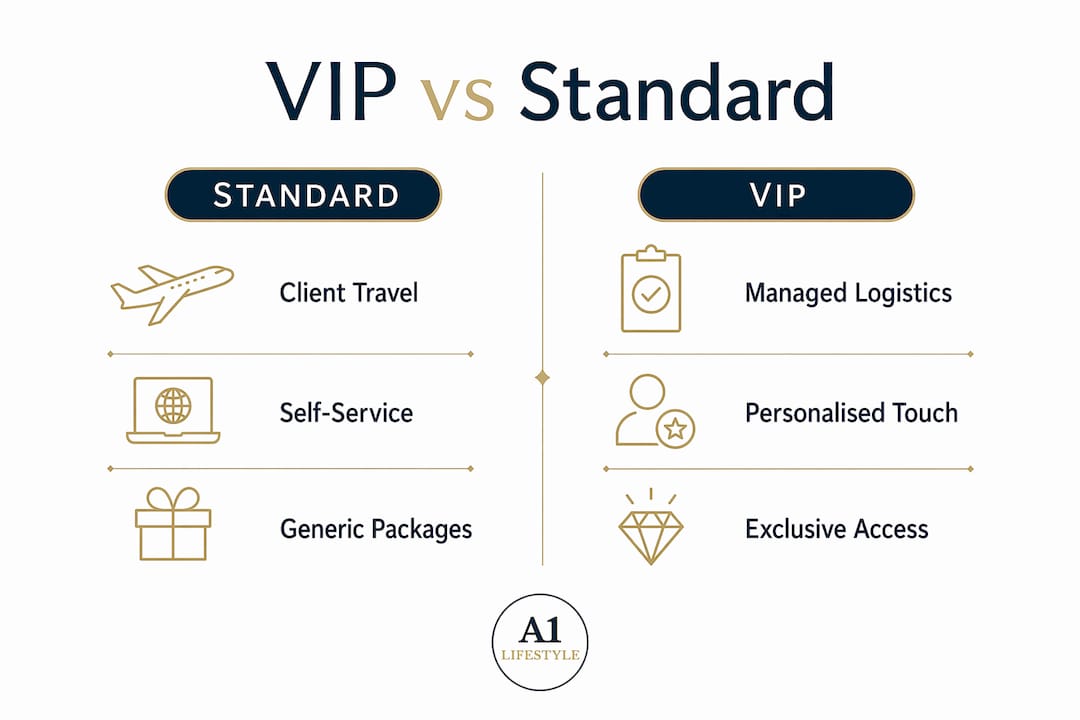
Businesses invest in experiences because products are easier to copy. A competitor can match a feature set or undercut a price. They cannot replicate the specific memory a client holds of an experience arranged exclusively for them. That is the strategic logic behind exclusive event access as a client engagement tool.
VIP programmes also create stories that fuel advocacy and organic reach beyond the transaction. A client who attends a private box at a sold-out concert or a backstage experience at a major festival does not keep that to themselves. They share it. That organic advocacy extends the commercial value of a single VIP investment well beyond the event itself.
Pro Tip: Avoid treating VIP access as a reward for past business. Position it as a recognition of the relationship's future potential. That framing shifts the client's perception from "thank you gift" to "valued partner."
Common mistakes businesses make with VIP investment
The most common error is treating VIP as a commodity purchase. Businesses book a hospitality package, hand over tickets, and assume the work is done. Many businesses fail precisely because bespoke, curated touchpoints yield far higher perceived value than boilerplate packages. The difference between a memorable experience and a forgettable one is almost always in the detail.
The pitfalls that most frequently undermine VIP investment include:
- Applying one format to all clients. A package that works for a technology executive may feel irrelevant to a client in the arts or sport. Segmentation is not optional.
- Neglecting the pre-event experience. The quality of communication, logistics briefing, and anticipation-building before the event shapes how the client arrives. Poor preparation signals poor attention to detail.
- Failing to follow up. A VIP experience with no structured follow-up is a missed commercial opportunity. The relationship capital built during the event needs to be converted into a next step.
- Measuring only cost, not return. Businesses that track VIP spend without measuring meeting conversion rates, deal velocity, or client retention cannot make informed decisions about future investment.
Technology and AI enhance operational efficiency but heighten the importance of authentic human VIP experiences for differentiation. As more client interactions move to digital channels, the scarcity and memorability of a well-executed in-person experience increases. That scarcity is itself a commercial asset.
How to implement a VIP programme that delivers returns
A VIP programme that delivers measurable returns requires four components: account identification, experience design, integration with broader marketing, and continuous measurement.
-
Identify your highest-value accounts. Use revenue data and pipeline analysis to identify the 1–5% of accounts that drive the majority of your commercial outcomes. These are the clients who warrant VIP investment. Spreading VIP resources too broadly dilutes the impact and the budget.
-
Design experiences around the client, not the event. Start with what you know about the client's interests, preferences, and schedule constraints. Then select the experience that fits. A client who follows boxing may respond more strongly to ringside access than to a corporate golf day. A client who attends music festivals may value VIP concert access over a formal dinner.
-
Integrate VIP into account-based marketing. Structured VIP programmes function best as part of account-based marketing and are measured continuously for improvement. VIP events should align with deal stages, renewal cycles, and relationship milestones. An experience timed to coincide with a contract renewal conversation carries more weight than one delivered at random.
-
Measure both financial and qualitative returns. VIP investments yield not only financial but also qualitative benefits such as improved brand loyalty and client advocacy. Track meeting conversion rates, sales cycle length, and client retention alongside softer indicators like referral activity and client satisfaction scores.
-
Build in a follow-up structure. Within 48 hours of any VIP event, send a personalised communication that references a specific moment from the experience. This converts the emotional capital of the event into a concrete next step in the commercial relationship.
The value of premium experiences compounds when they are part of a deliberate programme rather than a one-off gesture. Hospitality packages that impress clients consistently outperform ad hoc entertainment spend because they are designed with a commercial outcome in mind from the start.
Key takeaways
Businesses that invest in VIP experiences consistently outperform those relying on standard engagement because personalised, friction-free access creates relationship depth that competitors cannot replicate through pricing or product features alone.
| Point | Details |
|---|---|
| Account concentration drives ROI | Focus VIP investment on the 1–5% of accounts that generate 60–80% of revenue. |
| Live interaction closes deals | VIP experiences accelerate enterprise decision-making at the late stages of the sales cycle. |
| Personalisation is the differentiator | Bespoke experiences outperform generic packages in perceived value and client retention. |
| Integration multiplies returns | VIP programmes deliver the highest returns when aligned with account-based marketing and deal timelines. |
| Measure beyond cost | Track meeting conversion, sales velocity, and client advocacy alongside financial spend. |
The case for experience investment is stronger than it looks on a spreadsheet
The financial case for VIP investment is clear enough once you map it to account concentration and sales cycle data. What surprises most business leaders is how much of the return is qualitative and how long it compounds.
I have seen businesses spend significantly on VIP packages and measure nothing beyond the invoice. That is not a VIP strategy. That is hospitality spend dressed up as one. The businesses that extract real value treat every experience as a data point in a longer relationship arc. They know which client attended, what they responded to, and what conversation followed.
The other observation worth making is this: as AI and automation flatten the product landscape, the ability to create a genuinely memorable human experience becomes rarer and therefore more valuable. Experience-based investment is a defensive strategy. It builds relationship moats that competitors cannot cross by adjusting a feature or a price.
The businesses I respect most in this space do not ask "what is the cheapest VIP option?" They ask "what experience would this specific client remember in five years?" That question leads to better decisions, better relationships, and better commercial outcomes. The qualitative return on a well-placed VIP experience is not soft data. It is the foundation of long-term revenue.
— Tony
A1lifestyle VIP access for corporate client entertainment
A1lifestyle has over 30 years of experience arranging exclusive access to sold-out events across sport, music, and entertainment. For business leaders looking to invest in client experiences that are genuinely memorable, the range of options covers Premier League hospitality, private boxes, and bespoke concierge services tailored to individual client profiles.
The concierge and experience services A1lifestyle provides are designed for corporate use, with logistics, access, and personalisation handled end to end. Whether the brief is a sold-out concert, a major sports event, or a private festival experience, A1lifestyle sources access that standard channels cannot. For business leaders who want VIP investment to deliver measurable relationship returns, that level of access and service is where the process starts.
FAQ
What are the main business benefits of VIP experiences?
VIP experiences accelerate sales cycles, improve client retention, and create competitive differentiation that cannot be matched by product features or pricing alone. The commercial return compounds across renewals, referrals, and advocacy.
How do businesses measure the ROI of VIP investment?
ROI is measured through meeting conversion rates, sales cycle length, client retention, and referral activity alongside qualitative indicators such as client satisfaction and brand advocacy.
Which clients should receive VIP treatment?
Focus VIP investment on the 1–5% of accounts that contribute 60–80% of revenue. Spreading VIP resources too broadly reduces impact and dilutes the budget available for high-value relationships.
What makes a VIP experience different from standard hospitality?
VIP experiences remove friction, personalise every touchpoint to the individual client, and create a controlled environment where substantive relationship-building is possible. Standard hospitality does none of these consistently.
How does VIP investment support account-based marketing?
Structured VIP programmes integrate directly with ABM by aligning experiences to deal stages, renewal cycles, and relationship milestones. This alignment turns a hospitality event into a deliberate commercial intervention rather than a social gesture.