

TL;DR:
- Event capacity limits are set by safety regulations, defining the maximum number of tickets that can be sold at an event. These limits directly influence ticket availability, allocation across categories, and dynamic pricing, especially at high-demand venues. Attendees should understand capacity constraints and act early, as prices rise near full capacity, and waiting can lead to missed opportunities or higher costs.
Event capacity limits define the maximum number of tickets that can be sold for any event, directly controlling ticket availability and shaping pricing from the moment sales open. These limits are not arbitrary. They are set by physical venue constraints, fire safety regulations, and legal frameworks enforced by authorities in the UK, Dubai, Tamil Nadu, and beyond. When a venue holds 20,000 people, that number is the hard ceiling on every ticket category, from general admission to VIP hospitality. Understanding how event capacity limits affect tickets gives attendees a clear advantage when planning purchases, especially for high-demand events where capacity sells out within hours.
How event capacity limits affect tickets from the ground up
Event capacity is not simply the number of seats in a building. Technical capacity often exceeds advisable capacity because fire safety and evacuation constraints reduce the number of people who can safely occupy a space at any one time. Professional assessments are required to determine a defensible, enforceable figure. This distinction matters because it means the ticket pool is frequently smaller than the raw floor space would suggest.
Regulatory frameworks reinforce this ceiling at every level:
- UK fire safety law requires venues to hold formal capacity assessments and maintain evacuation plans before any public event can be licenced.
- Dubai legislation introduced in June 2026 mandates strict legal safety ceilings with comprehensive public safety management plans as a condition of operating any public gathering.
- Tamil Nadu's 2026 SOP requires organisers of gatherings over 5,000 attendees to file applications 10 to 30 days in advance. Turnout exceeding 50% above the declared number is treated as a serious violation.
These rules exist because event capacity is not just a sales figure. It is a legal safety limit critical for evacuation planning and fire safety compliance. Organisers who exceed permitted numbers face licence revocation, fines, and in severe cases, criminal liability.
Pro Tip: Before purchasing tickets for a large festival or stadium event, check whether the venue has published its licensed capacity. This tells you exactly how scarce tickets will be and how quickly they are likely to sell.
How does capacity shape ticket availability and allocation?
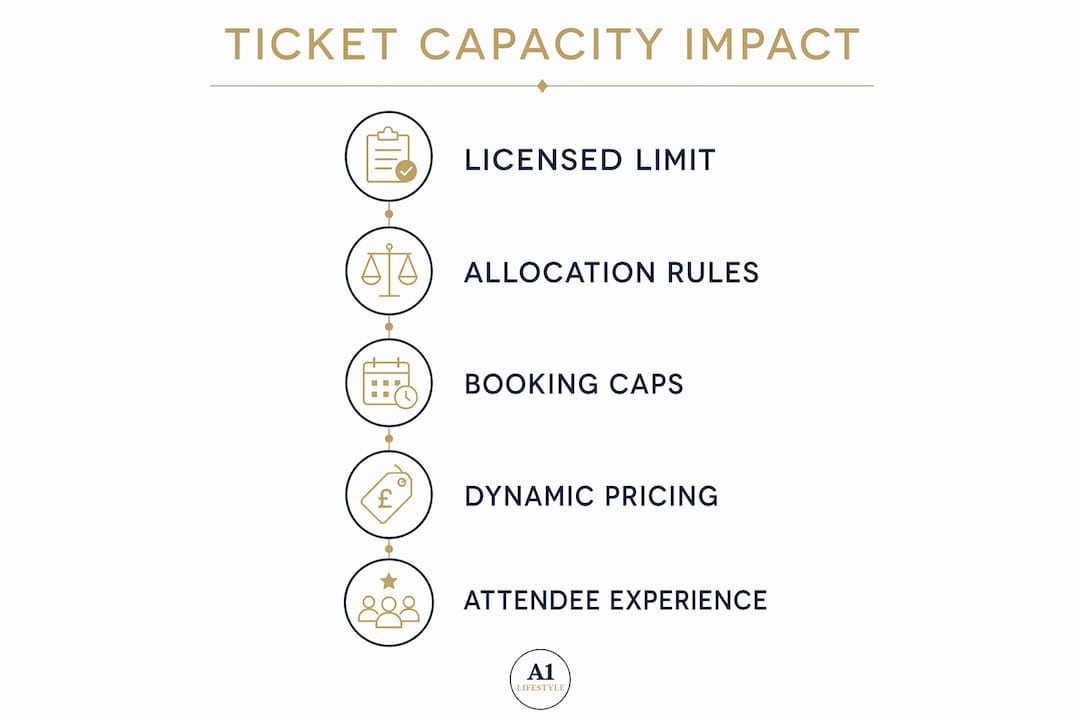
The total ticket pool for any event is capped at the licensed capacity figure. Within that pool, organisers divide tickets across multiple categories: general admission, seated, VIP, hospitality boxes, child tickets, and press or industry allocations. Each category draws from the same fixed total, which means expanding one category directly reduces availability in another.

The table below illustrates how a typical 15,000-capacity arena might distribute its ticket pool:
| Ticket category | Approximate allocation | Notes |
|---|---|---|
| General admission | 10,000 | Largest share, lowest price point |
| Seated standard | 2,500 | Fixed seating, mid-range pricing |
| VIP and hospitality | 1,200 | Premium pricing, limited release |
| Industry and press | 800 | Non-commercial, reduces public pool |
| Operational reserve | 500 | Held for safety and staff access |
The practical effect is that public-facing ticket availability is always lower than the headline capacity figure. For a 15,000-seat venue, a buyer competing for general admission is actually competing for roughly 10,000 places, not 15,000. Understanding ticket allocation methods helps attendees set realistic expectations before sales open.
Booking limits per transaction add another layer of restriction. Most platforms cap purchases at four to six tickets per order to prevent bulk buying and distribute availability more fairly. Dynamic adjustments also occur mid-sale. If VIP tickets sell out quickly, organisers sometimes release a small reserve batch, but this is at their discretion and is never guaranteed.
Pro Tip: If the ticket category you want sells out, check whether a ticket waiting list is available. Waiting lists activate when cancellations or reserve batches are released, giving registered buyers first access.
How do capacity constraints drive ticket pricing?
Capacity restrictions create scarcity, and scarcity drives price. Dynamic pricing manages demand by adjusting ticket prices in real time based on sales volume and the percentage of capacity already sold. When demand is high and capacity is nearly full, prices rise. When sell-through is low, prices drop to fill remaining seats.
Industry data illustrates how these thresholds work in practice:
- A-list arena acts exceed 94% capacity sell-through, which supports premium pricing throughout the sale window.
- Median amphitheatre tours operate at around 78% sell-through, where pricing remains stable but discounts begin to appear near the event date.
- Events falling below 60% sell-through trigger discount campaigns, sometimes called papering, where tickets are distributed at heavily reduced prices to fill the venue.
This means the price paid for a ticket is directly linked to how much of the venue's capacity has already been sold. Buying early, when capacity is largely unsold, often secures the best price. Waiting until close to the event date is a gamble. If the event is selling well, prices will have risen. If it is selling poorly, last-minute discounts may appear, but availability in preferred sections will be limited.
The strategic implication for attendees is straightforward. For high-demand events at venues with limited capacity, early purchase is the lower-risk option. For mid-tier events with larger venues, patience can occasionally yield savings, but it also risks missing out entirely on preferred seating categories.
What happens to the attendee experience at full capacity?
Filling a venue to its licensed maximum is not always the best outcome for those inside it. Operating at very high capacity can degrade the attendee experience through crowding, longer queues, stressed staff, and logistical bottlenecks at entry and exit points. The data supports a counterintuitive conclusion: 92% capacity with smooth operations produces better attendee satisfaction than 100% capacity with visible strain on infrastructure.
The consequences of poor capacity management extend beyond discomfort:
- Longer entry queues reduce time inside the venue and increase frustration before the event begins.
- Crowded concourse areas create safety risks and reduce access to food, drink, and facilities.
- Stressed operational staff are less able to respond effectively to individual attendee needs or minor incidents.
- Bottlenecks at exits slow evacuation and increase risk in emergency situations.
- Lower satisfaction scores reduce the likelihood of repeat attendance, which affects future ticket demand for the same venue or promoter.
"Effective capacity management balances sell-out appeal with quality attendee experience, reducing staff fatigue and logistical bottlenecks caused by crowded events." — The silent pressure behind a sold-out event
Attendees also carry legal exposure when capacity enforcement affects their tickets. Venue terms and conditions typically limit liability to a refund of face value if capacity enforcement cancels or revokes a ticket. Travel, accommodation, and other incidental costs are excluded. This makes understanding capacity risks before booking travel particularly relevant for events in unfamiliar venues or jurisdictions.
For practical guidance on securing tickets before capacity is reached, the A1lifestyle guide on securing high-demand tickets covers the most reliable approaches for 2026.
Key takeaways
Event capacity limits set a hard ceiling on ticket availability, and every pricing, allocation, and experience decision flows directly from that ceiling.
| Point | Details |
|---|---|
| Capacity is a legal limit | Licensed capacity is enforced by fire safety law and regional regulations, not set by organisers alone. |
| Ticket pools are smaller than capacity | VIP, press, and operational reserves reduce the public ticket pool below the headline venue figure. |
| Dynamic pricing tracks sell-through | Prices rise above 94% sell-through and fall below 60%, so timing a purchase affects cost directly. |
| Full capacity harms experience | Events at 92% capacity consistently outperform 100% capacity events on attendee satisfaction. |
| Refunds are limited by contract | Most venue terms cap liability at face value, excluding travel and accommodation if a ticket is revoked. |
Capacity limits and what they mean for the attendee
From years of observing how events sell and how attendees respond, the single most underestimated factor in ticket purchasing is the gap between headline venue capacity and actual public ticket availability. Most people assume that a 20,000-seat arena means 20,000 tickets for sale. The reality is closer to 14,000 or 15,000 once hospitality, press, industry, and operational reserves are removed. That gap is where most frustration originates.
The other pattern worth noting is how dynamic pricing catches buyers off guard. Attendees who wait, expecting prices to fall, are often correct for mid-tier events. For premium events at limited-capacity venues, the opposite is true. Prices at 90% sell-through are materially higher than at 40% sell-through, and the window between those two points can be as short as 48 hours for a high-profile act.
The practical advice is to treat capacity data as a purchasing signal, not background information. If a venue has a small licensed capacity and the act has a strong following, the combination of restricted supply and high demand means early action is the only reliable strategy. Waiting for a better deal at that point is not a strategy. It is a gamble with poor odds.
Understanding event seating categories before a sale opens also changes how buyers allocate their attention. Knowing which categories are most restricted helps prioritise where to focus in the first minutes of a sale.
— Tony
Secure your tickets before capacity closes the door

A1lifestyle has over 30 years of experience sourcing tickets for events where capacity makes standard availability unreliable. Whether the event is a Premier League fixture at a sold-out stadium or a limited-capacity VIP concert with restricted hospitality allocation, A1lifestyle operates through a global network that accesses tickets outside the standard public sale window. The team handles VIP hospitality, private boxes, and concierge services for clients who need confirmed access, not a waiting list. If capacity has already closed the public route, A1lifestyle is the direct alternative.
FAQ
What is an event capacity limit?
An event capacity limit is the maximum number of people permitted to attend an event at a specific venue, set by fire safety assessments, evacuation requirements, and regional licensing regulations. It defines the total number of tickets that can legally be sold.
Why do tickets sell out so quickly at some venues?
Small licensed capacity combined with high demand reduces the public ticket pool significantly, particularly when VIP, hospitality, and industry allocations are removed from the total. Events at venues with capacities below 5,000 are especially prone to rapid sell-outs.
How does capacity affect ticket prices?
Dynamic pricing adjusts ticket prices based on the percentage of capacity already sold. Prices rise as sell-through approaches 94% and fall when sell-through drops below 60%, meaning early buyers often secure better prices for high-demand events.
What happens if an event is cancelled due to capacity violations?
Most venue terms and conditions limit refunds to the face value of the ticket. Incidental costs such as travel and accommodation are excluded from liability, so attendees bear those losses directly.
Can capacity limits change after tickets go on sale?
Yes. Regulatory authorities can revise licensed capacity following safety inspections or changes in venue layout. Organisers may also voluntarily reduce capacity, which can result in ticket revocations from the highest-numbered allocations first.