

TL;DR:
- A dedicated host manages operations, staff, and client relationships during sports events to ensure memorable experiences. They handle logistics, supervise staff, and build long-term relationships through personalized service and feedback. The role is crucial for VVIP events, large groups, and client retention beyond the event itself.
A dedicated host in sports hospitality is the on-site operations lead and client relationship manager responsible for delivering frictionless, personalised experiences to premium guests. The role of dedicated host in sports hospitality extends well beyond greeting guests at the door. This person manages real-time logistics, supervises staff, handles VVIP protocols, and then shifts to relationship management between events to protect client renewals. For event organisers and corporate clients, understanding this role is the difference between a functional event and one that genuinely builds loyalty.
What are the primary responsibilities of a dedicated host during sports hospitality events?
A dedicated host carries full operational accountability from the moment the first guest arrives to the moment the last one leaves. Real-time logistics management covers guest arrivals, food and beverage coordination, credentialing, and issue resolution, all without disrupting the guest experience. This is not a support role. It is the central command position for the entire hospitality operation.
The core on-site duties of a dedicated host include:
- Guest arrival management: Coordinating transport, greeting sequences, and suite access so no guest waits or feels uncertain.
- Staff supervision: Directing VIP greeters, brand ambassadors, and catering teams to maintain consistent service quality throughout the event.
- Credentialing and VIP protocol: Managing access passes, seating hierarchies, and bespoke requests from high-value guests.
- Food and beverage coordination: Liaising with catering teams to time service around match or race schedules, not the other way around.
- Issue resolution: Handling complaints, logistical failures, or last-minute changes without escalating problems to the client.
- Technology and communications: Using on-site communication tools to coordinate across teams in real time, particularly during peak periods.
The host must also be briefed on high-priority guests and business objectives. Hosts manage the narrative of the day to facilitate intentional networking and meaningful connections, not just catering runs. A host who knows that two guests are potential business partners can engineer the right moment for an introduction. That is a skill no event management software replicates.
Pro Tip: Give your dedicated host explicit authority to spend up to a defined budget threshold to resolve issues on the spot. A host who must seek approval for every decision will always be one step behind the problem.

How does the dedicated host contribute to client relationship management beyond the event day?
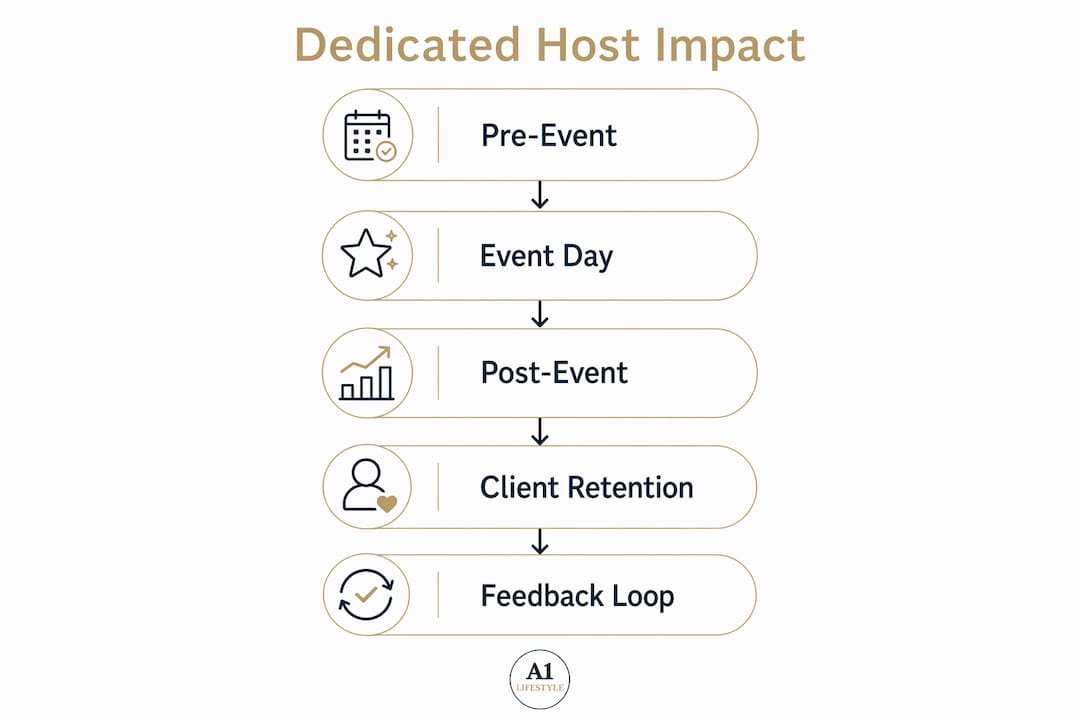
The dedicated host's responsibilities do not end when the final whistle blows. The host role shifts across event phases, moving from operational lead on the day to relationship manager in the weeks and months that follow. This dual function is what separates a truly effective host from a capable event-day coordinator.
The off-season relationship management cycle typically follows this sequence:
- Post-event debrief: The host collects structured feedback from guests and the corporate client within 48 hours, while impressions are still fresh.
- Feedback analysis: Findings are reviewed to identify service gaps, standout moments, and guest preferences to inform future planning.
- Personal rapport building: The host maintains regular, personal contact with key client stakeholders, not just transactional check-ins.
- Account risk identification: Any signals of dissatisfaction, budget pressure, or competitor interest are flagged and addressed before renewal conversations begin.
- Bespoke planning for the next event: The host uses accumulated knowledge of guest preferences to propose tailored upgrades or new experiences for the following season.
Premium sports hospitality hosts must transition from service providers to relationship managers, consistently justifying client investments through quality year after year. This is the commercial reality of the role. A corporate client spending significantly on a hospitality package expects the host to remember that their CEO prefers a window seat and their key client does not drink alcohol. Those details live with the host, not in a booking system.
Why is having a dedicated host critical for VVIP and large-group hospitality?
Standard VIP hospitality and VVIP hospitality are not the same product. VVIP hospitality demands a fully dedicated team and a single point of contact who ensures frictionless, bespoke experiences with all logistics managed invisibly. The guest should never encounter a problem, a queue, or an unanswered question. That level of execution requires a host with both authority and deep situational awareness.
The table below illustrates the key differences in host involvement across service tiers:
| Service tier | Host involvement | Key host responsibilities |
|---|---|---|
| Standard hospitality | Shared or rotational host | General guest management, basic F&B coordination |
| VIP hospitality | Dedicated host per suite | Personalised service, credentialing, staff supervision |
| VVIP hospitality | Dedicated host plus sub-team | Bespoke access, privacy management, narrative orchestration |
For events hosting 30–40 or more guests, a single host is structurally insufficient. Large group hospitality demands a hierarchical staffing approach with a dedicated hospitality captain supported by teams for registration, catering, and guest relations to maintain service without lapses. The host leads this structure, sets the standard, and intervenes wherever the system shows strain.
Privacy and exclusivity management is another area where the dedicated host is irreplaceable. VVIP guests often include executives, public figures, or major clients who require discreet handling. The host controls who approaches them, manages media exposure, and ensures the environment feels curated rather than crowded. Understanding how stadium hospitality levels work is the foundation for structuring these teams correctly.
Pro Tip: For groups of 30 or more, assign a named deputy host who shadows the lead host throughout the event. If the lead host is occupied with a VVIP issue, the deputy maintains full operational coverage without any visible gap in service.
What practical steps can event organisers take to optimise dedicated hosts?
The quality of a dedicated host is directly proportional to the preparation invested before the event begins. Hosts operating in premium sports hospitality must maintain consistent service quality across demanding multi-day schedules, which requires both training and the right operational infrastructure.
Practical steps for event organisers include:
- Invest in sports hospitality-specific training: General hospitality experience is a starting point. Hosts working at Premier League matches, Formula 1 races, or major boxing events need training in the specific protocols, guest profiles, and pressure points of those environments.
- Provide comprehensive pre-event briefings: Every host should receive a detailed guest profile document covering names, roles, preferences, dietary requirements, and the client's business objectives for the day.
- Equip hosts with decision-making authority: An effective dedicated host has authority to solve problems instantly without escalating to clients. Organisers must define this authority clearly before the event.
- Use coordinated staffing structures: A specialised hospitality staffing approach provides coordinated VIP greeters, brand ambassadors, catering teams, and on-site coordinators under unified management. The dedicated host leads this structure.
- Build post-event feedback loops: Structured feedback collected by the host within 48 hours of the event feeds directly into the next planning cycle, reducing repeat errors and identifying new opportunities.
The role of sports hospitality in fan experience is well documented, but the host is the mechanism through which that experience is actually delivered. Without a capable, empowered host, even the best hospitality package underperforms.
Pro Tip: Keep all host-to-client communications personal and direct. A brief message from the host the day before the event, confirming arrangements and inviting any last-minute requests, sets a professional tone and reduces day-of surprises.
Key takeaways
A dedicated host is the single most important operational and relational asset in a premium sports hospitality programme, covering logistics, staff leadership, and client retention across the full event cycle.
| Point | Details |
|---|---|
| Operational command | The host manages arrivals, F&B, credentialing, and issue resolution in real time throughout the event. |
| VVIP service tier | VVIP events require a dedicated host plus a structured sub-team to deliver frictionless, private experiences. |
| Off-season relationship role | After the event, the host shifts to relationship manager, gathering feedback and preparing renewal strategies. |
| Decision-making authority | Hosts must have explicit authority to resolve issues on the spot without client escalation. |
| Large-group structure | Groups of 30 or more guests require a hierarchical hosting team led by a named hospitality captain. |
Why the host role is the most undervalued asset in sports hospitality
Having observed premium sports hospitality programmes across major sporting occasions, the pattern is consistent. Clients remember the host, not the canapés. When an event goes well, guests credit the atmosphere. When it goes wrong, they remember the person who failed to fix it. The host is the face of the entire investment.
The uncomfortable truth is that many event organisers treat the dedicated host as a staffing line item rather than a strategic appointment. They hire for availability rather than capability, and then wonder why client retention suffers. The most successful hosts I have seen operate more like account directors than event staff. They know their clients' businesses, anticipate problems before they surface, and treat every event as a chapter in a longer relationship.
Technology is changing the role, but not replacing it. Communication tools and guest management platforms make logistics faster. They do not replace the human judgement required to read a room, manage a difficult guest, or know when to give a VVIP space rather than attention. The hosts who thrive in 2026 combine operational discipline with genuine interpersonal intelligence.
Treating the dedicated host role as a strategic investment, rather than an operational cost, is the single clearest differentiator between sports hospitality programmes that retain clients and those that lose them at renewal.
— Tony
Sports hospitality with expert dedicated hosts from A1lifestyle
A1lifestyle has over 30 years of experience providing premium sports hospitality across the world's most sought-after events.
From Premier League hospitality to Formula 1 and major boxing occasions, A1lifestyle pairs clients with expert dedicated hosts who manage every detail from arrival to departure. The full events calendar covers a wide range of high-profile sporting occasions, each supported by personalised concierge services and experienced on-site hosts. Corporate clients and event organisers can contact A1lifestyle directly to discuss bespoke hospitality planning, including dedicated host staffing tailored to group size, guest profile, and business objectives.
FAQ
What does a dedicated host do at a sports hospitality event?
A dedicated host manages guest arrivals, staff coordination, food and beverage service, credentialing, and real-time issue resolution. The host acts as the single operational lead for the entire hospitality suite or lounge.
How many guests require a dedicated host in sports hospitality?
Events hosting 30–40 or more guests require a dedicated host supported by a structured team covering registration, catering, and guest relations to maintain consistent service throughout the event.
What is the difference between VIP and VVIP hospitality hosting?
VIP hospitality uses a dedicated host per suite for personalised service, while VVIP hospitality requires a dedicated host plus a sub-team managing bespoke access, privacy, and narrative orchestration for the highest-tier guests.
How does a dedicated host support client retention after an event?
The host collects structured feedback within 48 hours, maintains personal contact with key client stakeholders, and uses guest preference data to plan tailored experiences for the following season.
What qualifications does a dedicated sports hospitality host need?
Sports hospitality hosts require experience in hospitality management, staff supervision, and budget management, typically from hotel, event, or restaurant backgrounds, combined with the ability to perform under pressure across multi-day events.