

A ticket broker is a person or business that buys tickets with the intention of reselling them for profit, operating as an ongoing commercial activity rather than an occasional bit of spare-ticket offloading. Brokers exist because demand for major events outstrips supply the moment a show sells out, and they profit from the gap between face value and what a desperate fan will pay.
In 2025, more than 61 million concert tickets were resold digitally in the United States alone, with online marketplaces handling roughly 86% of all secondary transactions. That scale tells you brokers aren't a fringe activity: they're a structural part of how tickets move once the primary sale ends.
Here's what you need to know at a glance:
- A broker buys outright or sells on consignment, acting as the middleman between the original ticket and the final buyer, charging a fee for the service.
- The BOTS Act makes it illegal in the US to use automated software to bypass ticket-site security or buy under false identities, though enforcement varies widely by state.
- Reselling itself has been legal in most markets for decades; the real friction is inflated prices and opaque fees, not the practice of resale.
- A1lifestyle operates as a lawful concierge alternative, sourcing verified access to sold-out events without the guesswork of an open resale listing.
Key Takeaways
Ticket brokers profit from the gap between face value and market demand, using presales, automation and inventory tools that ordinary fans don't have access to.
| Point | Details |
|---|---|
| Brokers operate as businesses | Professional brokers buy at scale using presales, bots and insider access, unlike casual sellers offloading a spare ticket. |
| Automation drives supply grabs | Bots, proxies and anti-detect browsers let brokers clear inventory within seconds of a sale opening. |
| Markup is stacked, not flat | Final resale prices combine broker markup, buyer fees and processing costs, often adding 40 to 70% over face value. |
| Legal status varies by method | Reselling itself is broadly legal, but the BOTS Act criminalises the automated buying methods many brokers rely on. |
| Guarantees matter more than price | A platform's buyer guarantee and payment protection often matter more than the headline price on a listing. |
| A1lifestyle offers a verified alternative | For sold-out or VIP access, A1lifestyle provides concierge-sourced tickets and hospitality rather than open resale speculation. |
Table of Contents
- The role of ticket brokers explained: who's actually selling you that ticket
- How brokers actually get their hands on so many tickets
- How resale marketplaces set the price you actually pay
- What the law says about buying and reselling tickets
- The real risks buyers face and how to cut them down
- What professional brokers sound like from the inside
- Should you actually use a broker?
- Why understanding this market matters more than picking a side
- A verified route to sold-out events, without the resale guesswork
- Sources
- FAQ
The role of ticket brokers explained: who's actually selling you that ticket
Not every reseller is a broker, and the difference matters more than most fans realise. Understanding the role of ticket brokers explained properly starts with sorting the market into four rough tiers, because scale and intent shape everything from pricing to risk.
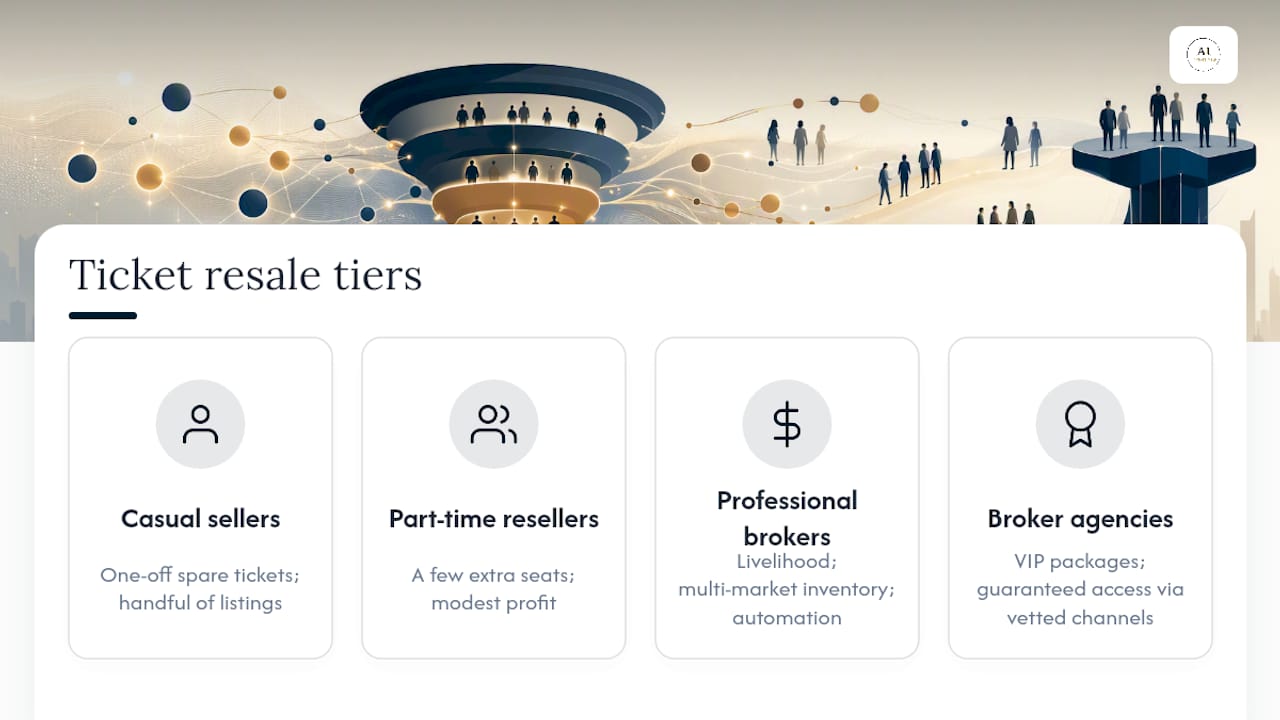
Casual or occasional sellers are ordinary fans who bought two tickets, can't go anymore, and list the spares once. They have no inventory strategy and usually no more than a handful of listings across their entire selling history.
Part-time resellers buy a bit more deliberately: a few extra seats for a popular tour, sold across one or two platforms for modest profit. They're dabbling, not building a business.
Professional brokers treat resale as their livelihood. They hold significant working capital, run inventory across multiple marketplaces simultaneously, and often specialise in particular genres, teams or venues where they've built purchasing relationships.
Broker agencies and concierge services operate at an entirely different scale, sourcing VIP packages, hospitality suites and guaranteed access through vetted channels rather than speculative resale. This is the tier A1lifestyle sits in, prioritising verified inventory and service over volume speculation.
The practical distinction between a professional and an individual usually comes down to scale and intent. Professionals buy inventory as a business and lean on automation tools that a one-off seller never touches.
Pro Tip: If a seller has dozens of listings for the same event across different price points, uses instant digital transfer, and lists tickets for shows that only just went on sale, you're dealing with a professional broker, not a fan clearing out spares.
How brokers actually get their hands on so many tickets
Brokers don't queue with everyone else. They exploit specific access points built into the primary ticketing system, and each method has a different scale and legality profile.
Fan-club and sponsor presales. Artists and promoters routinely open early-access windows to fan-club members or credit-card sponsor customers before general sale. Brokers join fan clubs en masse or use dedicated sponsor cards purely to unlock this early inventory, buying at face value hours before the public ever gets a chance.
Season-ticket packages. Sports brokers often hold season tickets for multiple teams specifically to access individual games, particularly marquee fixtures, at the lower season-ticket rate rather than single-game pricing.
Venue and insider allocations. Some brokers maintain relationships with box offices, promoters or venue staff who release blocks of tickets outside the public sale entirely. This is harder to detect and harder to regulate, since the transaction never touches a public platform.
Platform presales. Ticketing platforms themselves run presale codes tied to credit cards, radio stations or artist newsletters. Brokers collect codes from multiple sources to multiply their access windows.
General-sale automation. This is the method that draws the most scrutiny: bots, anti-detect browsers and rotating proxy networks that simulate hundreds of individual buyers hitting "purchase" simultaneously the second a sale opens. Brokers using this method can acquire inventory at a scale no human clicking a mouse could match.
Buy-and-hold speculation. Some brokers purchase tickets purely as a bet that demand will rise closer to the event, similar to how traders speculate on limited-edition sneakers or collectibles.
Last-minute bulk buys. Others watch for fans who can no longer attend and buy their tickets cheaply close to the event, then relist at a markup to buyers desperate for last-chance access.
Venues and primary sellers fight back with several defensive layers:
- Verified Fan programmes that require identity registration before presale access.
- CAPTCHA challenges and bot-detection software that flags rapid-fire purchasing patterns.
- Purchase limits tied to a single verified account rather than a payment card.
- Non-transferable or mobile-only tickets requiring the original buyer's ID at entry.
Reported margins: Broker interviews and industry reporting suggest many professionals target net profit margins of roughly 28–40% after platform fees, though this shifts considerably by event demand, season and how early inventory was secured.
Pro Tip: On-sale day, if a show sells out in under sixty seconds and identical seats reappear on resale sites within the hour at double the price, that's a strong signal automated buying, not organic fan demand, cleared the inventory. Fans frustrated by tickets disappearing instantly often assume the show was simply popular, when bot activity is frequently the bigger factor.
How resale marketplaces set the price you actually pay
Resale platforms work like any open marketplace: sellers list inventory, buyers compare, and price moves with demand rather than sitting fixed at face value. A single seat can carry a dozen different listed prices depending on who's selling it and how badly they want a quick sale.
Ticketmaster runs its own verified resale channel alongside primary sales, giving it visibility into original allocation that pure resale platforms lack. StubHub operates as an independent marketplace aggregating listings from individual sellers and brokers across a huge range of events, backed by a FanProtect guarantee. Viagogo functions similarly as an international resale marketplace, though it has drawn regulatory attention in several markets over pricing transparency and has faced enforcement action tied to misleading availability claims. None of these differences make one platform inherently safer than another; they simply source and guarantee inventory in different ways.
Before trusting any listing, check:
- Whether the platform offers a buyer guarantee covering invalid or non-delivered tickets.
- The seller's rating and transaction history, where visible.
- Whether fees are shown upfront or only added at checkout.
- Exact seat, section and row details, not just a price and a photo.
- The transfer method, and whether it matches what the venue actually accepts.
Here's a simplified worked example showing how a face-value ticket becomes a resale price, using generic figures to illustrate the structure rather than any specific platform's actual fee schedule:
The gap between face value and final price rarely comes from one source. It's markup, buyer fees and processing costs stacked together, which is exactly why two listings for the same seat can differ by fifty pounds with no obvious reason. Readers weighing why tickets cost more than expected will recognise this stacking effect as the usual culprit.
What the law says about buying and reselling tickets
Reselling tickets is legal in most markets and has been for decades. The controversy isn't the practice itself but the methods some brokers use to acquire inventory unfairly and the fees they add without disclosure.
In the United States, the BOTS Act specifically targets automated purchasing: using software to defeat security measures, buying under false identities, or circumventing per-account purchase limits are all federal offences. Enforcement, however, sits largely with individual states, which explains why bot activity persists despite the law's existence, and why rules on broker licensing and fee disclosure vary considerably from one region to the next.
For UK buyers, the practical position is simpler to navigate: check whether a platform is a member of a recognised consumer protection scheme, confirm the seller's registration status where the marketplace requires one, and always pay by a method that offers payment protection. A move toward non-transferable tickets would reshape the resale market considerably, though it also raises real questions about consumer ownership of something they've already paid for.
Before buying from any resale source, verify:
- The platform publishes a clear buyer guarantee and refund policy.
- Fees are itemised before you enter payment details, not revealed at the final step.
- The seller's registration or verification status, where the platform discloses it.
- Payment protection is available through your card provider or the platform itself.
Pro Tip: For genuinely current rules in your market, check your national consumer protection authority's website directly rather than relying on a resale platform's own summary of the law, which will naturally be written to favour continued trading.
The real risks buyers face and how to cut them down
Buying from a broker or an open resale listing carries risks that simply don't exist when you buy from a verified source. The most common is a fake or invalid ticket, sold to multiple buyers or generated from a screenshot rather than a genuine transfer. Double-selling happens when a broker lists a ticket speculatively before actually owning it, betting they'll source a genuine one before the buyer notices. Hidden fees appear at the final checkout step after you've already committed mentally to the purchase, and mobile-only transfers can fail entirely if the listed seat requires the original buyer's ID at the gate.
Cut the risk with a short checklist before you commit:
- Buy only from platforms offering an explicit buyer guarantee against invalid tickets.
- Pay by credit card where possible, since chargeback protection gives you recourse if the ticket never arrives.
- Check the seller's transaction history and rating rather than trusting a fresh, unrated account.
- Confirm the exact transfer method matches what the venue will accept at entry.
- Compare at least three listings for the same seat category before buying, since price spread often reveals which sellers are overreaching.
- For high-value VIP packages, use a reputable concierge service rather than an anonymous marketplace listing.
Watch for these red flags on any listing:
- A price dramatically below every other listing for the same section.
- Pressure language urging you to "buy now before it's gone."
- No stated refund policy or an evasive answer when you ask about one.
- A seller unwilling to confirm exact seat location before payment.
If something goes wrong, your recourse depends on how you paid. Platform guarantees typically cover invalid tickets outright, card chargebacks give you a second line of defence with dispute windows usually running 120 days from the transaction, and some marketplaces offer partial refunds for significantly misdescribed seats.
Pro Tip: Always pay the resale portion by credit card rather than debit card or bank transfer. Credit card protections tend to offer stronger dispute rights, and combined with a platform's own guarantee, you effectively get two separate safety nets on one purchase.
What professional brokers sound like from the inside
Professional brokers talk about tickets the way traders talk about stock. Reported interviews describe a mindset built around speculation: which artist is about to break out, which fixture will spike in demand, which city's demographics support a higher markup. It's less about loving the show and more about reading a market, applying the same logic used in sneaker and collectible resale to live events.
Operationally, professionals lean on:
- Inventory-management software that lists the same ticket across multiple marketplaces simultaneously.
- Multi-platform auto-uploaders that adjust pricing automatically as demand shifts.
- Proxy networks and account-management tools to run several buying identities at once.
Margins in the trade: industry reporting places typical broker net margins around 28 to 40% after platform fees, though a single high-demand event can push that considerably higher, while a poorly judged purchase can wipe out the margin entirely if demand fails to materialise.
Brokers, in short, operate as small trading businesses. Some are single individuals working evenings around a day job; others run as full syndicates with staff dedicated purely to sourcing and pricing.
Should you actually use a broker?
The right answer depends entirely on what you're buying and why. Three scenarios cover most real situations fans encounter.
If you need guaranteed access to a sold-out VIP experience, a corporate box, or hospitality package, a reputable concierge service beats a speculative resale listing every time, because verified inventory removes the double-sell and invalid-ticket risk entirely. If you're price-sensitive and just want a standard seat, avoid brokers altogether and wait for verified resale platforms or official ticket-exchange schemes, where markup tends to be lower and guarantees are built in. If you're an occasional buyer chasing a specific one-off show, a verified resale platform with a strong buyer guarantee is usually the sensible middle ground.
The trade-off always comes down to three variables: cost, guarantee, and time saved. Paying more for certainty makes sense when the stakes are high and time is short; it makes far less sense for a routine gig where patience saves money.
Pro Tip: A reasonable premium for guaranteed, hassle-free access to a genuinely sold-out event sits somewhere in the range most brokers already charge, around 30 to 40% over face value. Anything dramatically beyond that, without a clear service justification like hospitality or a private box, deserves a harder look.
Why understanding this market matters more than picking a side
The debate around ticket brokers rarely stays neutral for long, and I understand why. Fans see inflated prices and assume bad faith; brokers see a market responding rationally to scarcity. Both things are true at once. What actually protects you isn't outrage, it's knowing exactly how tickets move from box office to resale listing, and which safeguards separate a fair transaction from a risky one. That's why A1lifestyle focuses on verified access rather than open speculation, and it's worth checking our current event listings if guaranteed entry matters more to you than chasing the cheapest possible price.
A verified route to sold-out events, without the resale guesswork
A1lifestyle exists for exactly the moment an open resale listing feels like too much risk. Where a broker or marketplace listing leaves you checking seller ratings and hoping the transfer works on the night, A1lifestyle sources access directly through a global network built over more than 30 years, meaning you're not gambling on a stranger's inventory.

That translates into three concrete advantages over a typical resale purchase: verified inventory rather than speculative listings, VIP hospitality and private box options that standard resale platforms rarely offer at all, and a dedicated concierge who handles the booking rather than leaving you to interpret a listing's fine print. Whether you're after a hospitality package for a marquee fixture like Arsenal or a full experience through the concierge services team, the process starts with a straightforward enquiry rather than a bidding war against other buyers on a public listing. Get in touch to check availability for your event and see what a guaranteed booking actually looks like.
Sources
The claims and figures in this article draw on the following reporting and regulatory sources:
- Online ticket brokering
- Behind the Ticket Resale Curtain, Part 1: Who Are Ticket Brokers?
- What Is a Ticket Broker: Roles, Regulations, and Fees - LegalClarity
- Congress
- What is a Ticket Broker? - TicketSeating Support
For a deeper look at buying safely, read why buying from ticket specialists makes sense for high-demand events, or explore A1lifestyle's full event listings directly.
FAQ
What is the main role of a ticket broker?
A ticket broker's main role is sourcing and reselling tickets on the secondary market for profit, acting as an intermediary between the original ticket allocation and the fan who ultimately buys it.
What do ticketing staff do differently from brokers?
Ticketing staff work for the venue or promoter managing the official sale, seating allocation and entry systems, while brokers operate independently on the resale side, buying and reselling inventory they've already acquired.
Are ticket brokers reliable?
Reliability varies enormously: a registered agency with a buyer guarantee is far more dependable than an anonymous individual listing on an open marketplace, which is why checking seller verification matters before you pay.
Is it legal to buy from a ticket broker?
Buying resold tickets is legal in most markets, though the methods some brokers use to acquire that inventory, particularly automated bot purchasing, are illegal under laws like the BOTS Act in the United States.
How can I tell if a listing is from a legitimate broker?
Look for a clear buyer guarantee, transparent fees shown before checkout, a verifiable seller rating, and exact seat details rather than a vague description, since legitimate operations disclose all of this upfront.
When is it worth using a concierge service instead of a broker?
A concierge service like A1lifestyle makes more sense than an open resale listing when you need guaranteed VIP access, hospitality or a private box, since verified sourcing removes the double-sell and invalid-ticket risk entirely.