

TL;DR:
- High demand, engineered scarcity, and psychological triggers drive rapid event sell-outs, often coordinated by fan communities. Ticketing phases, presale holds, and phased releases further manipulate perceived availability, while fans respond immediately due to FOMO. Understanding these techniques helps buyers navigate the market beyond panic purchasing and recognize that some sell-outs are strategically manufactured.
Events sell out fast because high demand collides with deliberately constrained supply, and that collision is engineered as much as it is organic. The industry term for this is demand-supply compression, and it operates through three simultaneous forces: coordinated fan behaviour, calculated scarcity tactics by promoters and artists, and psychological triggers that push buyers to act within seconds of tickets going on sale. Platforms like Ticketmaster and See Tickets add a further layer through phased releases and virtual queue systems that shape who gets access and when. Understanding these forces explains why events sell out so fast and why the experience feels so chaotic for the average buyer.
Why do events sell out so fast?
Fan communities are the single fastest accelerant in modern ticket sales. Platforms like Discord and X allow thousands of fans to coordinate purchase attempts at the exact moment tickets go on sale, creating a simultaneous surge in demand that no inventory system is built to absorb. Coordinated fanbase actions via digital communities and virtual queue systems are a primary driver of rapid sell-outs. This is not a passive phenomenon. It is organised, rehearsed, and executed with precision.
K-pop fandoms are the clearest example of this in practice. Groups like BTS and BLACKPINK have global fan networks that share countdown timers, browser refresh strategies, and account pre-registration guides days before a sale opens. The result is that tens of thousands of purchase attempts land within the first thirty seconds of a sale going live. No venue on earth holds enough seats to satisfy that volume of simultaneous demand.
The same dynamic applies to Western artists with devoted fanbases. Taylor Swift's Eras Tour and Beyoncé's Renaissance Tour both saw Ticketmaster queues exceed one million users within minutes of opening. The queue itself becomes a psychological event, with fans sharing screenshots of their position and fuelling further urgency among those who have not yet joined.
- Fan Discord servers often share browser extensions and autofill tools to speed up the checkout process.
- X (formerly Twitter) countdown threads create synchronised purchase waves at sale time.
- Presale codes distributed through fan clubs give organised buyers a head start over the general public.
- Virtual queues randomise position, meaning early login does not guarantee early access.
Pro Tip: Register for an artist's official fan club or mailing list at least two weeks before a tour announcement. Presale codes are almost always distributed through these channels first, giving access before the general public sale begins.
How does engineered scarcity drive rapid sell-outs?
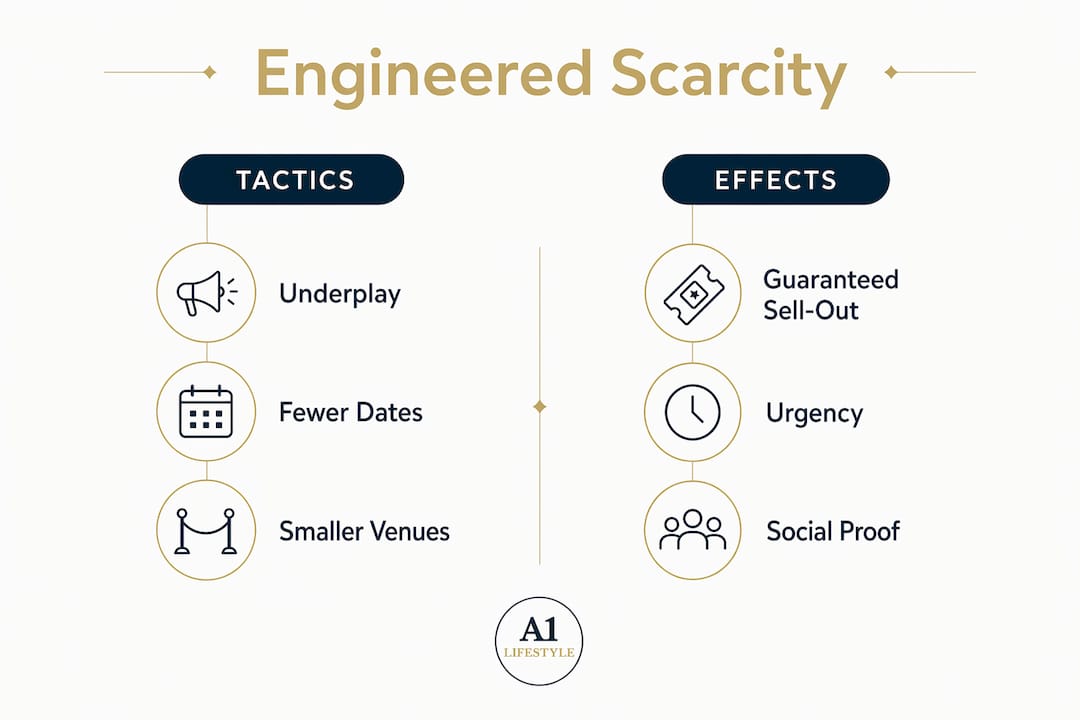
Engineered scarcity is the deliberate restriction of ticket supply to create urgency and social proof. Scheduling fewer dates and smaller venues creates urgency and sell-out optics that amplify perceived value. This is a calculated marketing decision, not a logistical constraint.

The tactic known as an underplay is a direct application of this principle. Underplays are strategic bookings involving smaller venues than demand would justify, designed to manufacture sold-out shows and leverage hype for future event demand. An artist who could fill an arena books a theatre instead. The show sells out in minutes, generates press coverage, and the artist's team uses that sold-out status to justify higher ticket prices and larger venues on the next tour.
Event organisers also treat scarcity as a product in its own right. Unique, unrepeatable experiences are now designed deliberately to drive demand and premium pricing. Features like phone-free zones, exclusive backstage access, and limited-capacity VIP tiers all reduce the number of available tickets while increasing the perceived value of each one.
| Tactic | Effect on sell-out speed |
|---|---|
| Underplay (smaller venue than demand) | Guarantees sell-out; generates press and social proof |
| Fewer tour dates in key markets | Concentrates demand into fewer on-sale windows |
| Limited VIP or premium tiers | Reduces general admission inventory; creates tiered urgency |
| Exclusive experiences (phone-free, backstage) | Increases perceived value; attracts premium buyers quickly |
Pro Tip: Watch for artists announcing a single date in a major city rather than multiple nights. A single date signals either a genuine capacity constraint or a deliberate underplay. Either way, the sell-out window will be short.
What psychological factors make fans buy tickets immediately?
FOMO, or fear of missing out, is the primary psychological driver behind rapid ticket purchases. Marketing highlighting limited availability triggers emotional buying to avoid missing out, and promoters design their communications specifically to activate this response. The phrase "limited tickets remaining" is not informational. It is a behavioural prompt.
Social proof compounds FOMO significantly. When a buyer sees that a ticket tier has already sold out, or that a venue is listed as 99% sold, the remaining tickets feel more valuable than they did moments before. This is loss aversion in action: the psychological pain of losing access to something outweighs the rational calculation of whether the ticket price represents fair value. Fans respond to sell-out frenzy by prioritising immediate purchase to avoid missing a once-in-a-lifetime experience.
Tiered pricing structures reinforce this behaviour. When early-bird or standard tickets sell out and only premium tiers remain, buyers who hesitated feel penalised. This teaches the market to act faster next time. Promoters know this, and the pricing architecture is designed with that conditioning in mind.
- Countdown timers on ticketing pages increase purchase urgency by making time scarcity visible.
- "Only 10 tickets left" notifications trigger immediate action regardless of actual inventory levels.
- Social media posts showing sold-out tiers create public proof of demand, drawing in buyers who were undecided.
- Tiered pricing punishes delay, training fans to buy at the earliest opportunity.
Understanding how to secure tickets for high-demand events requires recognising these psychological mechanisms before they operate on you.
How do ticketing platforms create the appearance of instant sell-outs?
Ticketing platforms release inventory in phases, and a significant portion of seats is withheld from the public sale entirely. Significant seats are withheld for presales and technical holds, affecting public availability and creating the impression of an instant sell-out when the general sale opens. A venue that holds 20,000 people may release only 8,000 tickets to the public on the first day.
The phenomenon known as blue dot fever describes this clearly. 'Blue dot fever' describes the situation where unsold tickets remain invisible to consumers due to promoter allocations and internal holds, leading to perceived rapid sell-outs despite actual inventory. Buyers see a sold-out page and assume all tickets are gone. In reality, thousands of seats remain in artist holds, sponsor allocations, venue holds, and presale pools that have not yet been released.
Tickets also move through a hidden lifecycle involving phases of availability, resale, price shifts, and last-minute market changes. A show that appears sold out in January may have seats return to sale in March as holds are released or corporate allocations go unused.
| Phase | What happens to inventory |
|---|---|
| Presale window | Fan club, credit card, and sponsor allocations released first |
| General sale | Reduced public inventory goes live; appears to sell out quickly |
| Hold release | Artist and venue holds returned to sale weeks or months later |
| Resale market | Secondary platforms list tickets, often at inflated prices |
| Last-minute release | Unsold corporate or sponsor tickets enter the market close to the event |
Understanding how ticket allocation works across these phases is the most practical knowledge a buyer can have.
Do economic conditions affect which events sell out quickly?
Economic pressures have split the live events market into two distinct groups. Rising ticket prices and macroeconomic pressures have created a K-shaped demand curve, with affluent buyers maintaining high spending and price-sensitive fans priced out entirely. This means the fastest sell-outs now tend to cluster at the top and bottom of the market: premium VIP packages and low-cost festival day tickets both move quickly, while mid-range seated tickets for mid-tier artists often linger.
Competition from major global events also concentrates discretionary spending. Economic pressures and competition from major events like the 2026 FIFA World Cup influence which concerts sell out instantly versus those with unsold seats. When a once-in-a-generation sporting event dominates the calendar, consumer budgets and attention shift accordingly.
The 2026 concert market has also seen a correction. Surplus supply and cancellations rather than fast sell-outs now characterise parts of the market, as promoters overestimated demand based on streaming metrics rather than actual fanbase size. Not every event sells out fast. The ones that do share a combination of genuine artist popularity, constrained supply, and effective psychological marketing.
- Events with genuine scarcity (one night only, limited capacity) sell out faster than extended runs.
- Artists with active, organised fan communities sell out faster than those with passive streaming audiences.
- Premium experiences with exclusive access sell out faster than standard seated shows at equivalent price points.
- Economic uncertainty pushes buyers towards either premium splurges or affordable options, squeezing the middle market.
Key takeaways
Events sell out fast because limited supply, coordinated fan demand, engineered scarcity, psychological triggers, and phased ticketing systems all operate simultaneously to compress the window between on-sale and sold-out.
| Point | Details |
|---|---|
| Coordinated fan action | Digital communities on Discord and X synchronise purchases, overwhelming inventory within seconds. |
| Engineered scarcity | Underplays and reduced tour dates are deliberate tactics to manufacture sold-out status. |
| Psychological triggers | FOMO and loss aversion push fans to buy immediately rather than deliberate. |
| Phased ticket releases | Public inventory is a fraction of total capacity; holds and presales reduce visible supply. |
| Economic polarisation | K-shaped demand means premium and budget events sell fastest; mid-tier events face more risk. |
The reality behind the sold-out sign
Having observed the live events market for a long time, the aspect that surprises most people is not the speed of sell-outs. It is how much of that speed is manufactured rather than organic. A sold-out show is not always proof of overwhelming demand. Sometimes it is proof of a well-executed scarcity strategy.
The frustration fans feel when tickets disappear in seconds is real, but it is worth separating the causes. Genuine demand from a devoted fanbase is one thing. A promoter releasing 40% of a venue's capacity to the public while holding the rest for sponsors and corporate packages is another. Both produce the same sold-out page, but they represent very different market realities.
My honest view is that buyers benefit from understanding the mechanics before they enter a sale. Knowing that a virtual queue randomises position, that holds will likely be released later, and that the secondary market follows a predictable price curve gives a buyer options beyond panic-purchasing at face value. The psychology of urgency is powerful, but it loses some of its grip once you can name it.
The call for greater transparency in ticketing practices is legitimate. Buyers deserve to know what percentage of a venue's inventory is available in the general sale. Until that becomes standard practice, understanding the system is the best available tool.
— Tony
Access sold-out events through A1 Lifestyle
When an event sells out before you reach the checkout, the standard options are the secondary market at inflated prices or missing out entirely. A1 Lifestyle provides a third option. With over 30 years of industry expertise and a global network of contacts, A1 Lifestyle secures access to VIP concerts, Premier League matches, and boxing events that have long since sold out through normal channels. The service includes VIP hospitality, private boxes, and personalised concierge support. For events where standard tickets are gone, A1 Lifestyle's access goes beyond what the public sale ever offered.
FAQ
Why do concert tickets sell out within minutes?
Concert tickets sell out within minutes because fan communities coordinate simultaneous purchase attempts at the exact moment of sale, and public inventory is often a fraction of total venue capacity due to presale holds and artist allocations.
What is engineered scarcity in live events?
Engineered scarcity is the deliberate restriction of ticket supply through smaller venue choices and fewer tour dates, designed to create urgency, generate sold-out press coverage, and increase perceived event value.
Does a sold-out event mean all tickets are gone?
Not always. A significant portion of tickets is typically held back for presales, sponsor allocations, and artist holds. These are often released closer to the event date or appear on the secondary market.
How does FOMO affect ticket buying behaviour?
FOMO causes fans to purchase tickets immediately at release rather than deliberating, because the psychological cost of missing out feels greater than the financial cost of the ticket. Promoters reinforce this through countdown timers and limited-availability messaging.
Can economic conditions affect how fast events sell out?
Yes. Rising ticket prices have created a split market where premium VIP packages and affordable festival tickets sell fastest, while mid-range events face slower sales. Competition from major global events like the 2026 FIFA World Cup also redirects discretionary spending.